
AI Basics · Explainer
AI vs Machine Learning vs Deep Learning: A Plain-English Guide for 2026
August 28, 2026 · 9 min read · by Emmanuel Abou Chabke
These three terms get used as if they mean the same thing, and that confusion costs people money. It is why beginners buy a six-month machine learning course when what they actually needed was two weeks of practice with ChatGPT. This guide untangles the words in plain English, shows where LLMs fit, and tells you which layer is worth your time.
Quick Answer
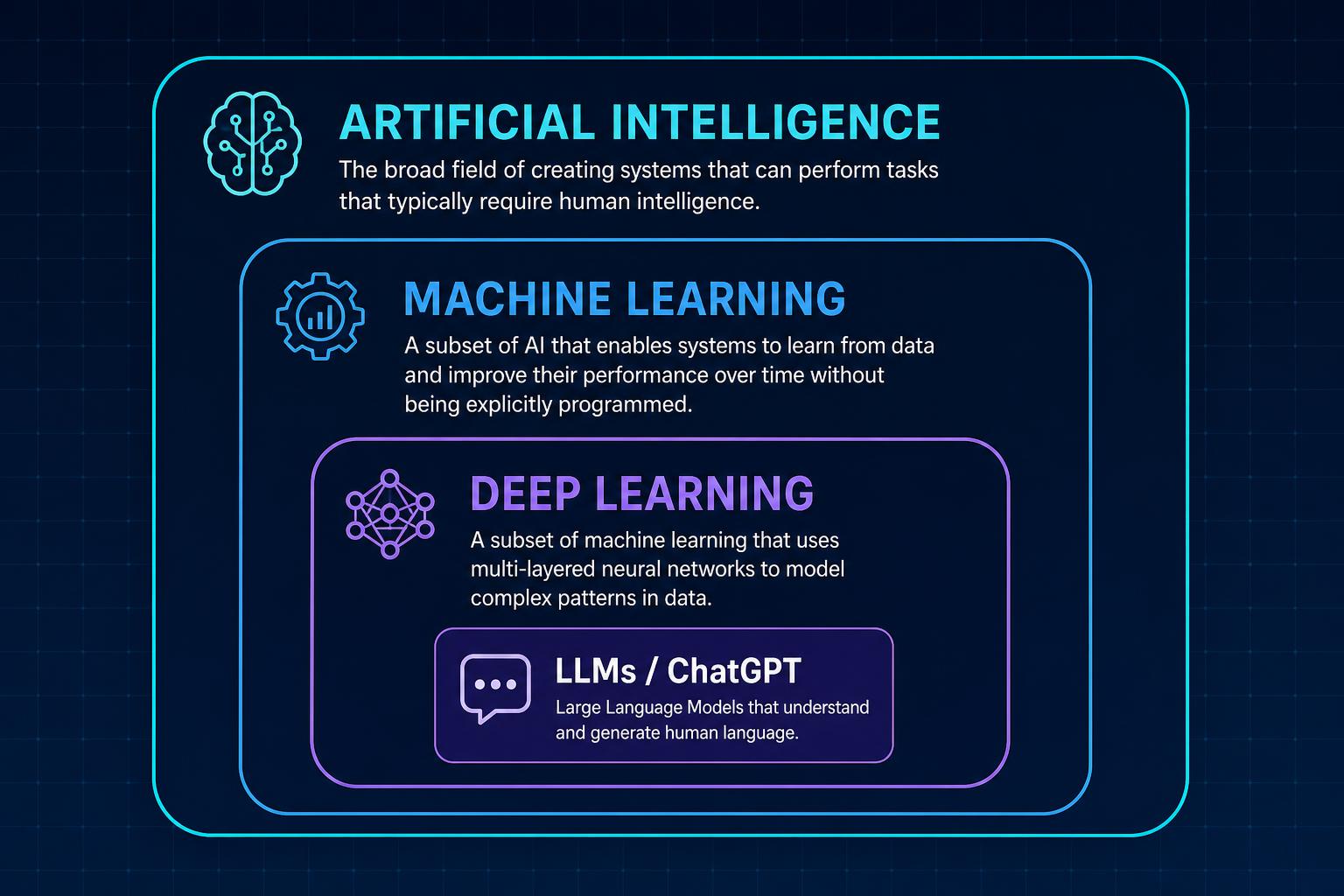
Artificial intelligence is the whole field. Machine learning is a method inside it where systems learn from data instead of hand-written rules. Deep learning is a subset of machine learning that uses multi-layered neural networks. ChatGPT is a large language model, so it is deep learning, so it is machine learning, so it is AI. They are nested circles, not rivals. And for 99% of people in 2026, the useful skill is the outermost, most practical one: knowing how to work with LLM tools. That is exactly what Chapter 1 | Best AI Tools for Beginners teaches, with 3 free minutes every month and no card required.
The Four Layers, Defined Properly
Layer 1
Artificial intelligence (AI)
The whole field. Any system that performs tasks we associate with human intelligence, from a chess engine with hand-written rules to a modern chatbot.
- Examples
- Rule-based chess engines, route planning, ChatGPT, recommendation systems.
- Who works at this layer
- Everyone. This is the umbrella term you see in headlines and job ads.
Layer 2
Machine learning (ML)
An approach inside AI where the system learns patterns from data instead of following rules a human wrote.
- Examples
- Spam filters, credit scoring, churn prediction, demand forecasting.
- Who works at this layer
- Data analysts, data scientists, ML engineers.
Layer 3
Deep learning (DL)
A subset of machine learning built on multi-layered neural networks. It handles messy, unstructured data like images, audio and language.
- Examples
- Face unlock, speech-to-text, self-driving perception, translation.
- Who works at this layer
- ML engineers, researchers, computer vision and NLP specialists.
Layer 4
Large language models (LLMs) and generative AI
Deep learning models trained on huge amounts of text that generate new language, code and reasoning steps on demand.
- Examples
- ChatGPT, Claude, Gemini, Copilot, local models on NPU laptops.
- Who works at this layer
- Everyone who writes, sells, teaches, markets, plans or builds.
The Simplest Analogy That Works
Think about transport. Transport is the field, that is AI. Motor vehicles are one way to do transport, that is machine learning. Electric cars are a specific kind of motor vehicle, that is deep learning. And the specific car in your driveway is ChatGPT.
Nobody learns "transport" in the abstract before driving. They learn to drive one car. The same logic applies here: you do not need the theory of the field to get value from the vehicle in front of you.
Where ChatGPT Actually Sits
A large language model is trained on an enormous amount of text to predict what comes next, and at scale that prediction turns into something that can summarise, translate, argue, plan and write code. Technically that makes ChatGPT a deep learning system. Practically, it makes it a tool you brief, like a very fast, very well-read assistant with no memory of your business unless you give it one.
This is why prompting matters more than architecture for most people. The model is fixed, your input is not. If you want the mechanics of that, read How to Use ChatGPT Effectively next.
Generative AI vs Traditional AI
There is one more split worth knowing, because it explains why 2023 onwards felt so different:
- Predictive or traditional AI | classifies and forecasts. Is this transaction fraud? Will this customer churn? What is in this photo? It has been quietly running banks and logistics for years.
- Generative AI | produces new content. Text, images, audio, video, code. This is the part ordinary people can now use directly, with no data team and no budget.
When somebody says "AI changed my work this year", they almost always mean generative AI.
Which One Should You Learn?
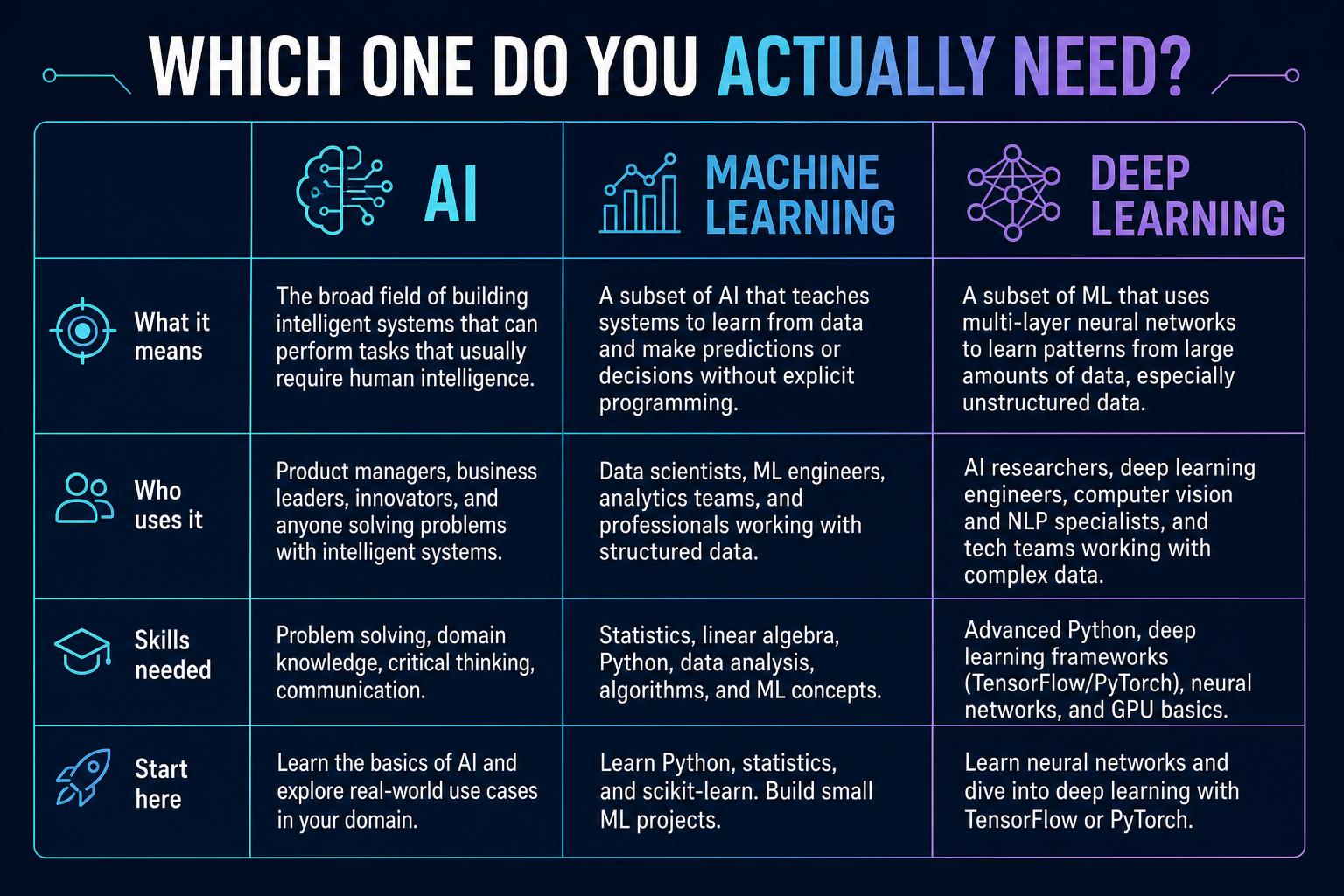
Pick by outcome, not by prestige. Here is the honest split:
- You want to work faster, write better, market, sell, teach or run a business | learn to use LLMs. No coding, no maths. Payoff in weeks.
- You want to analyse data and build predictions inside a company | learn machine learning. Python, statistics, SQL. Payoff in months.
- You want to build or fine-tune models | learn deep learning. Advanced Python, PyTorch, GPUs, linear algebra. Payoff in years.
Most people reading this belong in the first bucket, and the roadmap for it is laid out in How to Learn AI in 2026.
5 Mistakes This Confusion Causes
- Buying a machine learning course to learn ChatGPT. You end up doing linear regression homework instead of writing better prompts.
- Believing you need maths. Using an LLM well is a briefing skill. The maths belongs to the people building the model, not using it.
- Chasing certificates for the wrong layer. A deep learning certificate does not make you better at AI at work. See our certification demand research.
- Assuming AI is always learning from you. A trained model does not update itself from your chat. If you want it to remember your context, you have to supply it every time, which is why a prompt vault matters.
- Trusting output because it sounds technical. Generative models can be confidently wrong. Verification is part of the skill, not an optional extra.
Glossary of the Other Terms You Keep Seeing
- Neural network | a layered system of weighted connections loosely inspired by neurons. The engine under deep learning.
- Training | the expensive one-off process of teaching a model from data. Done by labs, not by you.
- Inference | the model actually answering you. This is what happens every time you hit send.
- Parameters | the learned values inside a model. More is not automatically better.
- Tokens | chunks of text the model reads and writes. Your context limit is measured in these.
- Hallucination | a fluent, confident, wrong answer. Always verify names, numbers and links.
- Prompt engineering | structuring your instruction so the output is usable first time.
- Fine-tuning | further training a model on your own examples. Rarely needed once good prompting is in place.
- RAG | retrieval-augmented generation, giving the model your documents at question time so answers are grounded.
- Local LLM | a model running on your own machine, increasingly viable on NPU laptops. More in Local LLMs on NPU Laptops.
The Shortcut: Learn the Layer That Pays
Market Me Global teaches the practical layer, using AI, not building it. No Python, no maths, no theory detours:
- Chapter 1 | Best AI Tools for Beginners | the tools, the prompting workflow, your first real outputs.
- Chapter 2 | Applying AI to Real Work | turning prompts into repeatable weekly workflows.
- Chapter 3 | Advanced Builds and Bonuses | ultra prompts, templates and the cinematic web walkthrough.
Every chapter gives you 3 free minutes each month, no card, so you can judge it before you spend anything. Top up whenever you want more.
Frequently Asked Questions
What is the difference between AI and machine learning?
Artificial intelligence is the whole field of building systems that do things we associate with human intelligence. Machine learning is one approach inside that field: instead of writing rules by hand, you show a program examples and it learns the patterns. So all machine learning is AI, but not all AI is machine learning.
Is deep learning the same as machine learning?
No. Deep learning is a subset of machine learning that uses multi-layered neural networks. It is what made image recognition, speech recognition and modern language models work. Plenty of useful machine learning, like spam filters and credit scoring, uses simpler methods that are not deep learning.
Is ChatGPT AI, machine learning or deep learning?
All three. ChatGPT is a large language model, which is a deep learning system, which is a form of machine learning, which sits inside the field of artificial intelligence. When people say they are learning AI in 2026, they usually mean learning to work with tools like ChatGPT, Claude and Gemini.
Do I need to learn machine learning to use AI at work?
No. Using AI at work is a communication and workflow skill, not a maths skill. You need to know how to brief a model, give it context, check its output and build repeatable prompts. Machine learning theory only matters if you plan to build or train models yourself.
Do I need to know Python or maths?
Only for the machine learning and deep learning side. If your goal is to use AI to write, sell, market, teach, plan or automate, you need no Python and no maths. If your goal is to train models, then Python, statistics and linear algebra become unavoidable.
What is generative AI and how is it different?
Generative AI is the branch of deep learning that produces new content, text, images, audio, video or code, rather than only classifying or predicting. ChatGPT, Claude, Midjourney and Sora are generative. A fraud-detection model is not.
Which one should I learn first in 2026?
Start with using AI, meaning LLM tools and prompting, because it pays off in weeks and needs no technical background. Move to machine learning later only if you want to become a data or ML professional. Most people who jump straight to machine learning courses quit before they get any practical benefit.
How long does it take to get useful with AI tools?
Two to four weeks of daily practice on real tasks is enough to change how you work. Market Me Global's Chapter 1 compresses that into a structured path, and you get 3 free minutes of every chapter each month so you can preview before paying.
Key Takeaways
- AI is the field, machine learning is a method inside it, deep learning is a subset of that method.
- ChatGPT is an LLM, so it is all three at once. The terms are nested, not competing.
- Generative AI is the part you can use directly today with no technical background.
- Learn to use LLMs first. Only go into machine learning if your goal is a data or ML role.
- Verification is part of the skill. Fluent output is not the same as correct output.