
AI Marketing · Playbook
How to Use AI in Marketing: A Practical 2026 Playbook
September 6, 2026 · 11 min read · by Emmanuel Abou Chabke
Short answer: use AI in marketing by picking one repeating task, briefing it like you would brief a junior hire, editing and fact-checking the output, then measuring whether it saved time without costing quality. Do that once, save the prompt, repeat. Everything below is the long version of those five steps, with the six places AI actually pays off and the parts you should never hand over.
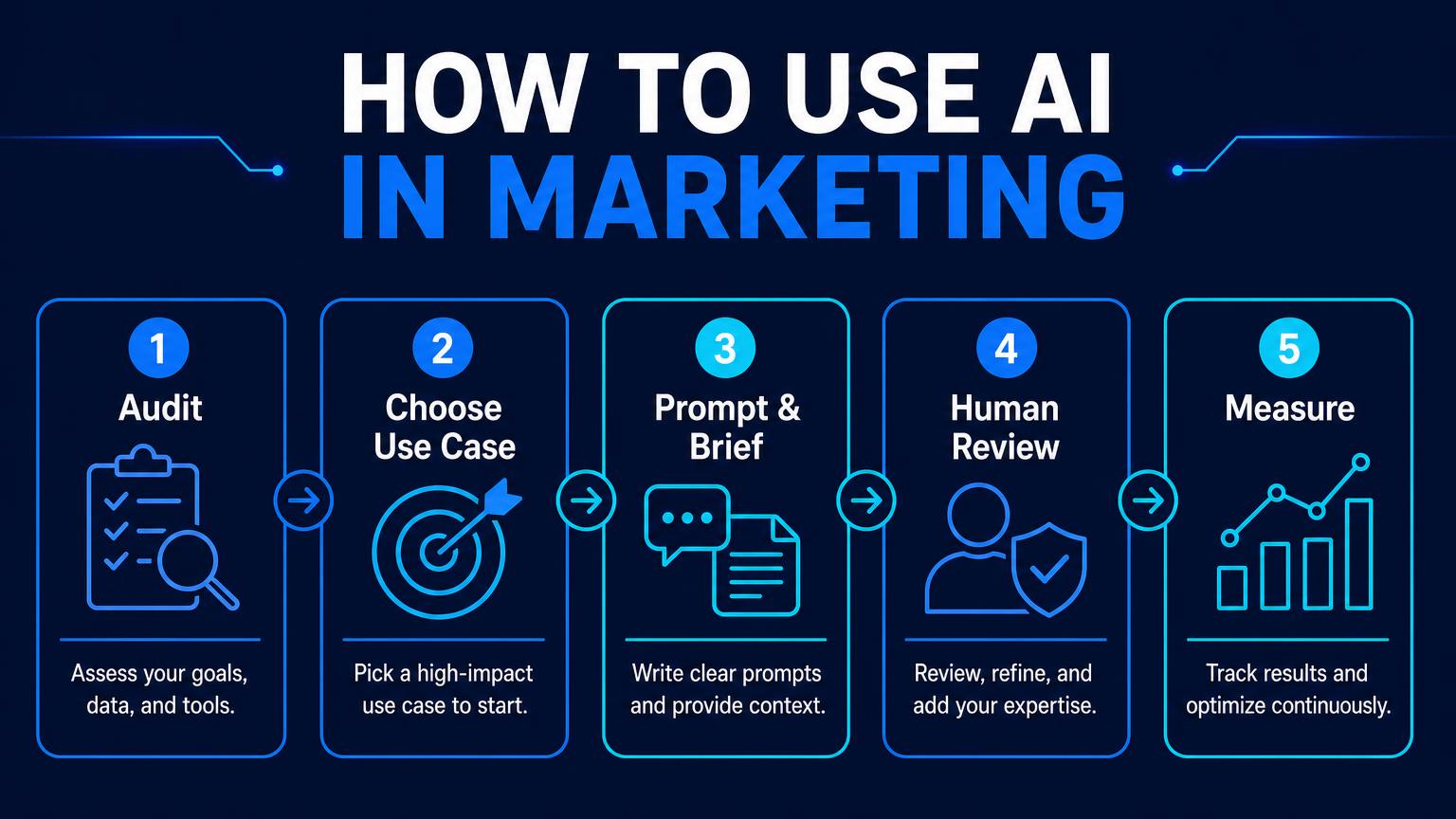
The 5-Step Workflow
Most teams adopt AI backwards. They pick a tool, then look for a job for it. The version that works starts with the work, not the software.
Step 1 | Audit where the time goes
List every recurring marketing task for two weeks with the hours each takes. AI pays off on high-frequency, low-judgement, text-shaped work. That list is your shortlist, not a tool review.
Step 2 | Pick one use case
Choose a single task with a clear definition of done, ideally one you repeat weekly. One task done properly beats six half-adopted, and it gives you a clean before-and-after to measure.
Step 3 | Write the brief as a prompt
Role, task, context, format, constraints. Context is the part the model genuinely cannot guess: audience, product, price, tone, what you already tried.
Step 4 | Review, edit and verify
Treat the output as a junior draft. Check every statistic, quote and product claim. Cut whatever sounds like AI. Your edits are the value you add.
Step 5 | Measure, then systemise
Track time saved and one output metric such as click-through, reply rate or published pieces. If the number moved, save the winning prompt as a template and repeat it. If it did not, drop the use case.
Step three is where most of the quality lives. If the output is generic, the brief was generic. The full breakdown of that five-part structure is in what is prompt engineering, and there are ready-made versions in 30 ChatGPT prompts for marketing.
Where AI Helps Across the Funnel
AI is strong on text-shaped, high-frequency, low-consequence work, and weak everywhere judgement or verified fact is the product. Here is that split by area, with what to keep for yourself.
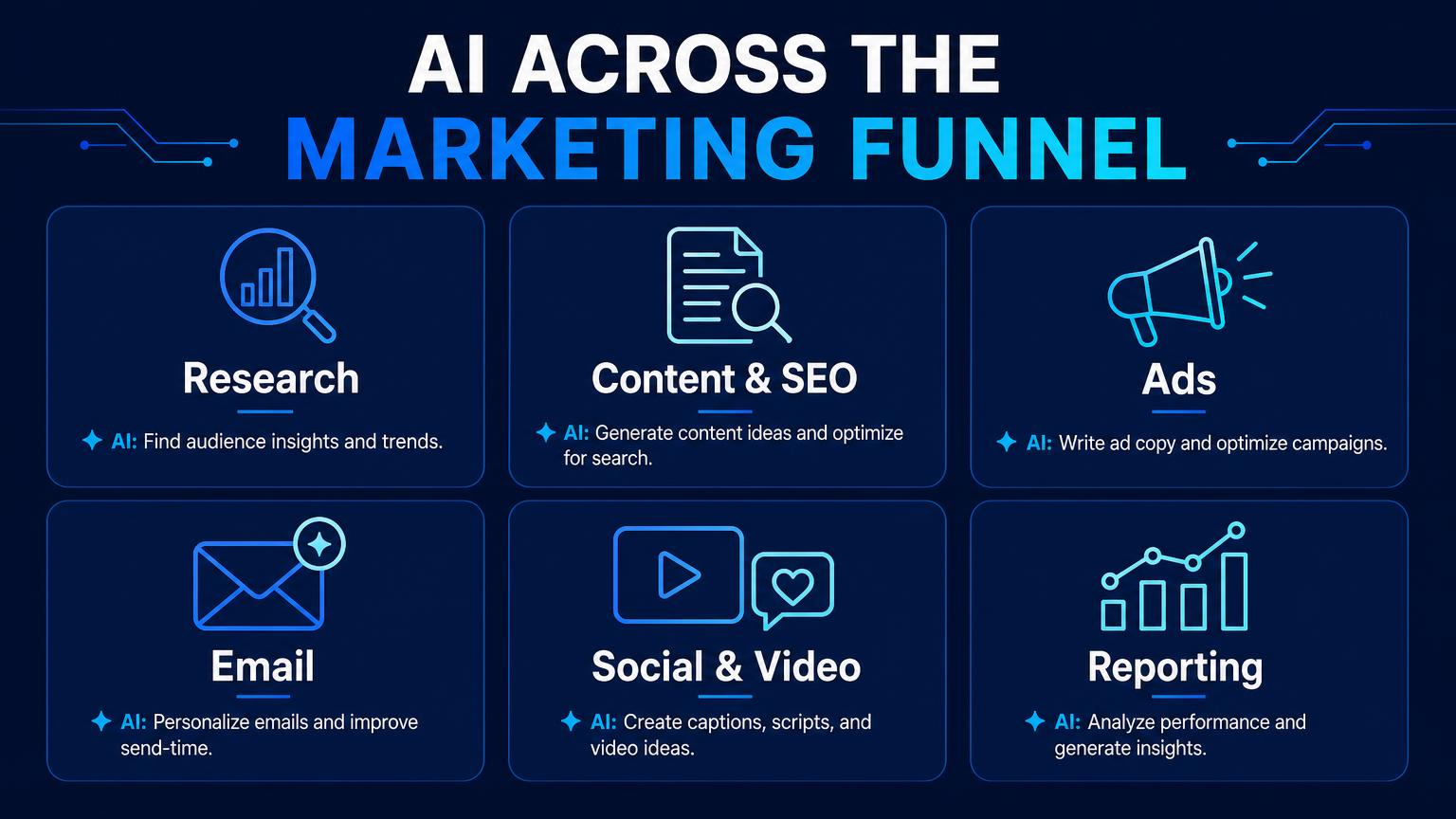
Research and audience
Start here, because most weak marketing is a research problem. AI is fast at clustering messy input into themes you can act on.
- Cluster survey answers, reviews and support tickets into named themes with counts
- Turn customer language into message angles you can test
- Summarise competitor pages and name the claims nobody is making
- Draft interview questions and then synthesise the transcripts
Keep human: Deciding which theme you actually build the quarter around.
Content and SEO
AI plans structure well and invents facts badly. Let it own the outline and the first draft, never the numbers.
- Build topic clusters and internal linking plans around a pillar term
- Turn a brief plus your own data into a first draft
- Write title tags, meta descriptions and FAQ blocks
- Audit an old article for what is outdated and what is missing
Keep human: Original data, expert opinion, and fact-checking every claim before it ships.
Paid ads
This is where the gain is measurable within 48 hours, because you can test variations at a volume no human writes by hand.
- Generate headline and hook batches by angle, then rank them
- Score message match between an ad and its landing page
- Write responsive search ad sets inside character limits
- Read test results and propose the next single-variable test
Keep human: Budget decisions, claims that need proof, and knowing when a winner is just noise.
Email and lifecycle
Email rewards specificity. Give the model the segment, the trigger and one action, and drafts come back usable.
- Draft welcome, win-back and checkout-recovery sequences
- Produce subject line test sets in three different styles
- Rewrite a long update into a 150-word version that keeps the point
- Personalise a template per segment without writing each one
Keep human: Offer design, discount policy and anything that touches a promise.
Social and video
The compounding move is repurposing. One good asset should become five, and the prompt is what does the converting.
- Turn one article into LinkedIn, X, carousel and short-video versions
- Write scripts with a hook in the first three seconds
- Draft caption variations that match a pasted brand voice
- Build a 30-day calendar mapped to content pillars
Keep human: Voice, taste, and the judgement call on anything that could age badly.
Analytics and reporting
Anonymise first, then let the model do the summarising and the narrative. It is very good at explaining numbers to people who hate numbers.
- Write a monthly report narrative for a non-technical stakeholder
- Diagnose the biggest funnel leak and rank plausible causes
- Explain whether an A/B result is worth acting on
- Convert raw notes into a shipped, learned, blocked stand-up
Keep human: Attribution judgement, and refusing to let a tidy story outrun the data.
If you want the tool-by-tool version of this, read best AI marketing tools in 2026 and the wider guide to AI in digital marketing. For the creative side specifically, there is generative AI for marketing.
What Stays Human
The line is easier than people make it. Hand over production, keep decisions.
- Strategy. What you sell, to whom, at what price, against which alternative.
- Truth. Every statistic, quote, case study and product claim gets a human source.
- Voice. The model imitates a voice you give it. It cannot invent one worth having.
- Relationships. Sales conversations, partnerships, community, apologies.
- Risk. Legal, compliance, accessibility, anything that could embarrass the brand.
The workplace policy version of this, including what not to paste, is in how to use AI at work.
How to Measure the Gain
"It feels faster" is not a result. Track five numbers on the task you chose in step two, before and after.
| Metric | How to measure | Healthy signal |
|---|---|---|
| Time per task | Hours before and after, same task, same person | 40 to 70 percent reduction on drafting work |
| Output volume | Pieces published or ad variants tested per month | 2x to 3x without a quality drop |
| Quality signal | Click-through, reply rate, or on-page engagement | Flat or better, never worse |
| Edit ratio | How much of the draft survives your edit | Rising over time as prompts improve |
| Error rate | Factual corrections caught in review | Trending to zero at publish |
These are practical benchmarks from our own workflows and student results, not published industry averages. Measure your own baseline rather than borrowing anyone's numbers, including ours.
7 Mistakes to Avoid
- Publishing the first draft. It reads like everyone else's first draft, because it is.
- Trusting statistics the model produced. Assume every number is invented until you have the source.
- Buying eleven tools before mastering one. Depth beats a stack.
- Pasting customer data into a chatbot. Anonymise first, and check the policy at your company.
- Skipping measurement, so nobody can tell whether the AI actually helped.
- Losing the brand voice by letting the model choose the tone instead of pasting samples of yours.
- Keeping everything in chat history, then never finding the prompt that worked.
The last one is the quiet killer. Keep working prompts in a dedicated vault such as AIQuickPrompt, with folders, search and one-tap copy. The free account is enough to start, and the reasoning is in why every LLM user needs a prompt vault.
Your First Week
- Day 1. Log every marketing task and the time it takes.
- Day 2. Pick the single most repetitive text task on that list.
- Day 3. Write the prompt in five parts and run it three times, improving the weakest part each round.
- Day 4. Ship one real output from it, fully edited and fact-checked.
- Day 5. Compare time and quality against your baseline, then save the winning prompt as a template.
- Weekend. Add exactly one more use case. Not five.
Where to Learn This Properly
Reading a playbook is the easy half. The academy is the guided version, built for marketers rather than engineers, by the team behind Market Me Global:
- Chapter 1 | Best AI Tools for Beginners | choosing tools, prompt structure, verification and your first real outputs.
- Chapter 2 | Using AI to Increase Productivity | turning proven prompts into weekly workflows, reports and automations.
- Chapter 3 | AI for Social Media, Captions and Posts | the ultra prompt pack, captions, carousels and AI video ads.
Every account gets 3 free minutes of each chapter every month, no card required. Chapter 6 will be a dedicated module on AI image and video generation, so stay tuned if that is your bottleneck.
Frequently Asked Questions
How do I use AI in marketing as a beginner?
Pick one repeating task, such as writing ad headline variations or summarising your monthly report. Write a prompt with five parts: role, task, context, format and constraints. Review and fact-check the output, then measure time saved and one performance metric. Once it works, save the prompt as a template and add a second use case.
What is AI used for in marketing?
The common uses are audience research and review clustering, content planning and drafting, SEO metadata and FAQs, ad copy variations, email sequences, social repurposing and short-video scripts, and turning campaign data into plain-English reports. In each case AI produces drafts and structure at speed, while a marketer supplies context, verification and judgement.
Can AI replace marketers?
No. AI has no knowledge of your customers, cannot verify its own facts, and carries no accountability for brand risk. What it does replace is the slow, repeatable part of the work. The marketers losing ground are the ones doing only that part, and the ones gaining are the ones briefing, editing and measuring well.
Which AI tools should a marketing team start with?
One general assistant such as ChatGPT, Claude or Gemini covers most text work. Add an image or video generator when you need creative volume, and a prompt vault so your best prompts are reusable. Add anything else only after you can name the task it does better than the assistant you already pay for.
How do I keep AI content from sounding generic?
Paste real samples of your voice, give the model actual data and customer language, ban cliches explicitly in the constraints, and always cut the first and last paragraph of a draft. Generic output is nearly always the result of a generic brief.
Is it safe to use AI with customer data?
Only after anonymising. Strip names, emails, account numbers and anything under NDA before pasting, check your company or client AI policy, and prefer tools with a business plan where inputs are not used for training.
How do I measure the ROI of AI in marketing?
Measure the same task before and after: hours spent, output volume, and one quality metric such as click-through or reply rate. If time drops and quality holds, the gain is real. If quality falls, the use case is wrong or the brief is thin.
Key Takeaways
- Start with the work, not the tool. Audit tasks first, then pick one.
- Brief AI in five parts: role, task, context, format, constraints.
- AI helps most in research, content, ads, email, social and reporting.
- Strategy, truth, voice, relationships and risk stay human.
- Measure time, volume and one quality metric, or you cannot tell whether it worked.
- Save every winning prompt. Reuse is where the compounding happens.
Based in Cyprus? Emmanuel also runs in-person AI seminars and one-to-one sessions in Paphos, Limassol, Nicosia and Larnaca, booked at least one week ahead.