
AI Marketing · Prompt Library
ChatGPT Prompts for Marketing: 30 Copy-Paste Prompts for 2026
September 2, 2026 · 12 min read · by Emmanuel Abou Chabke
Most prompt lists are padded. This one is not. Below are 30 marketing prompts we actually run, grouped by the six jobs marketers do every week: strategy, SEO and content, ads, email, social and reporting. Each one is written in the same 5-part structure, so once you have used a few you can write your own for any task and stop collecting other people's lists.
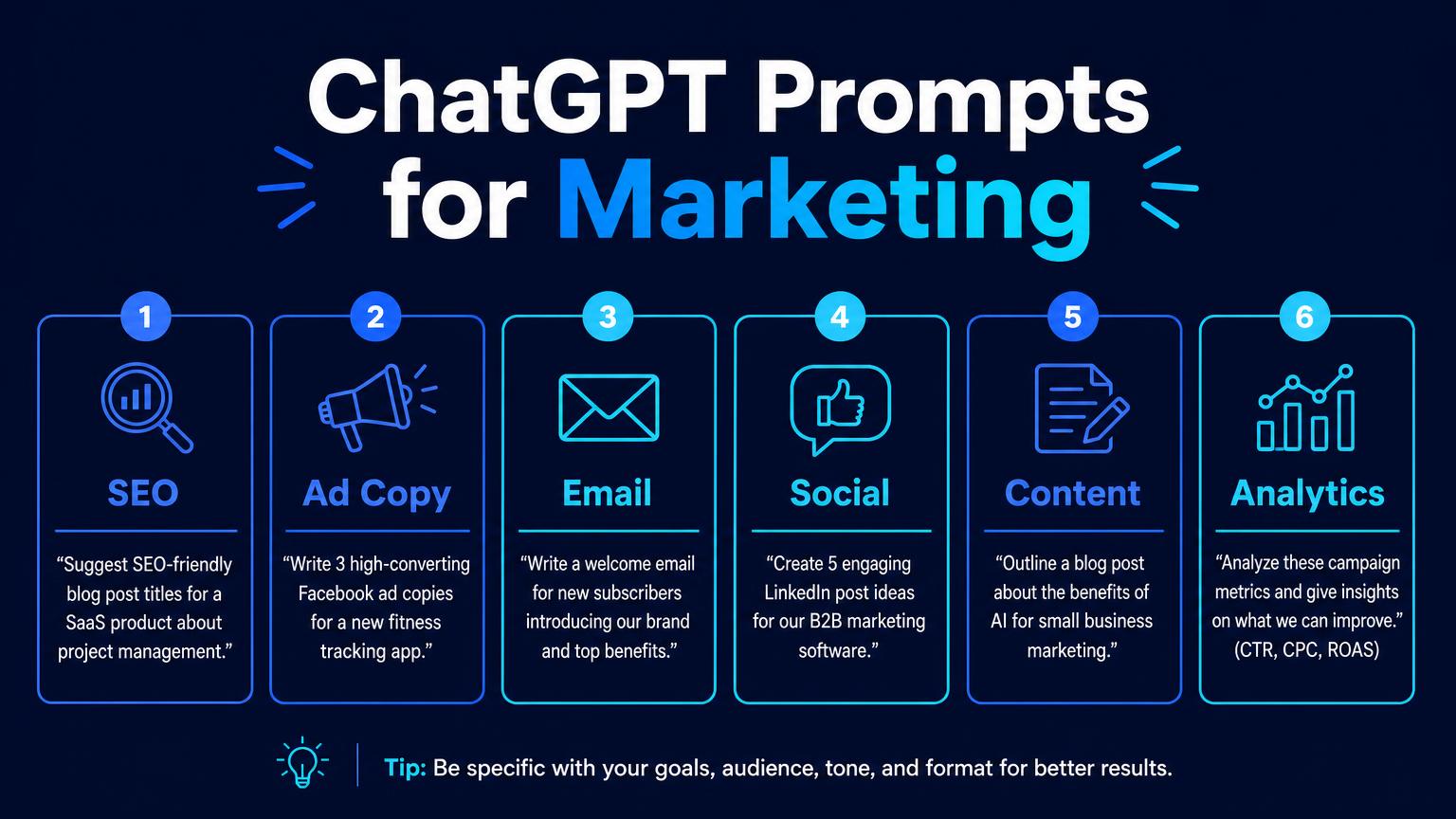
The Structure Behind Every Prompt Here
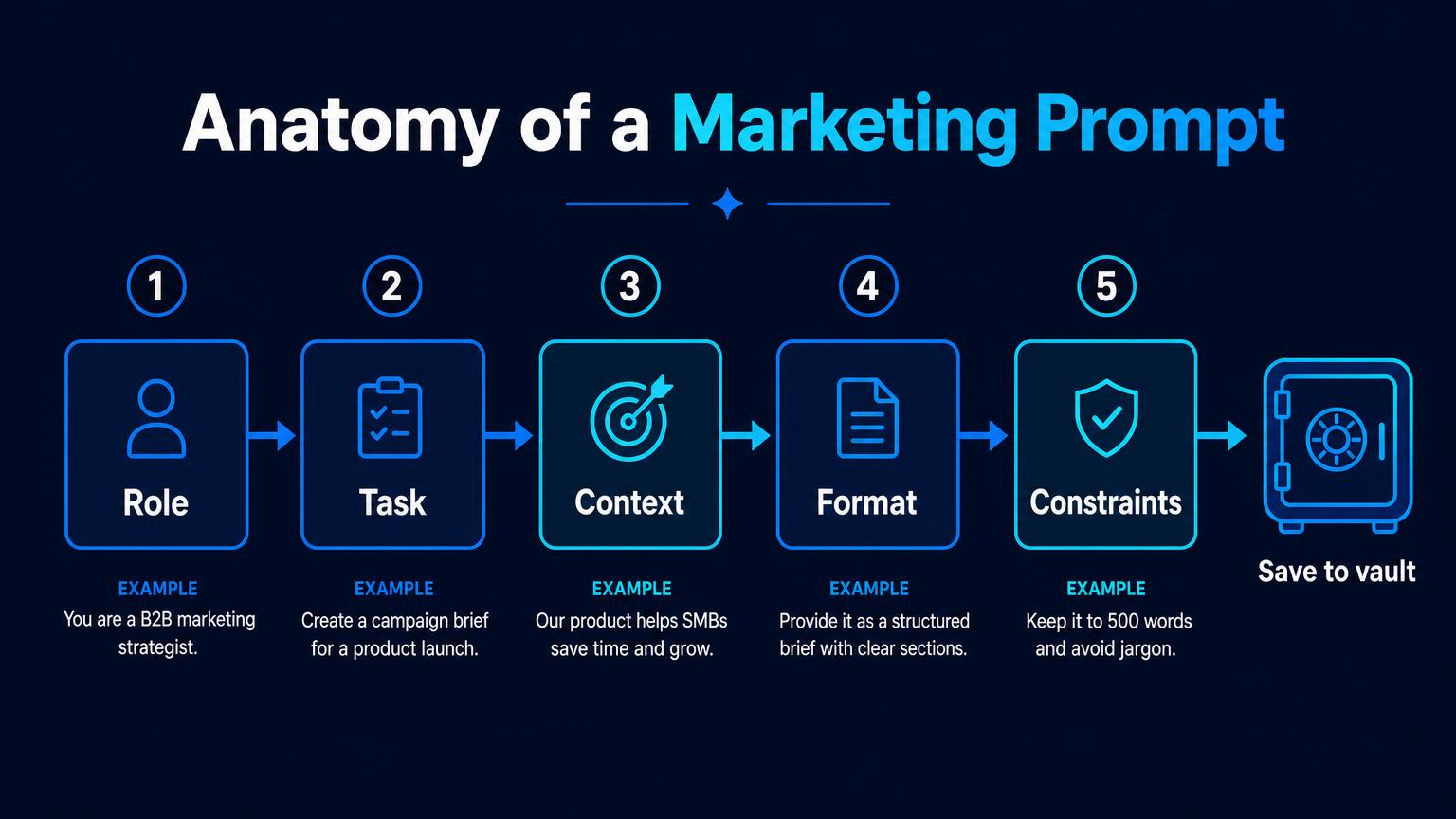
A prompt that works is just a good brief. Five parts, in this order, and the output stops being generic.
| Part | Example |
|---|---|
| Role | You are a senior performance marketer with 10 years of paid social experience. |
| Task | Write 10 Meta ad headlines for our AI course launch. |
| Context | Audience: non-technical marketers, 28 to 45, sceptical of AI hype. Price 60 EUR per chapter. |
| Format | Numbered list, each headline under 40 characters, then rank the top 3. |
| Constraints | No emojis, no superlatives, no invented statistics, no competitor names. |
Anything in [SQUARE BRACKETS] below is a placeholder. Replace it with your real audience, product, price and data. That single habit is worth more than any prompt on this page, because context is what the model genuinely cannot guess. The longer explanation of why lives in what is prompt engineering.
Strategy and positioning
Use these before you write anything. Most weak marketing copy is a positioning problem wearing a copywriting costume.
1. Customer pain map
You are a senior brand strategist. Our product is [PRODUCT] for [AUDIENCE], priced at [PRICE]. List the 8 problems this audience talks about in their own words, ranked by how urgently they feel each one. For each, give the exact phrasing they would use, the emotion behind it, and one message angle that speaks to it. No invented statistics.
2. Positioning statement
Act as a positioning consultant. Using this context: [PASTE PRODUCT NOTES]. Write 3 positioning statements in the format 'For [audience] who [need], [product] is the [category] that [benefit], unlike [alternative]'. Then name the strongest one and explain the trade-off it makes.
3. Competitor angle gap
Here is the homepage copy of 3 competitors: [PASTE]. Identify the claims all three make, the claims none of them make, and the 3 angles we could own without lying. Return a table with columns: angle, why it is open, proof we would need.
4. Offer stress test
You are a sceptical buyer in [AUDIENCE]. Here is our offer: [PASTE]. List the 7 reasons you would not buy, ranked by likelihood. For each, write the one sentence on the page that would remove the objection.
5. Campaign brief
Create a one-page campaign brief for [CAMPAIGN]. Sections: objective, single measurable KPI, audience, core message, proof points, channels, assets required, timeline, definition of done. Keep it under 400 words, no jargon.
SEO and content
ChatGPT is excellent at structure and terrible at facts. Let it plan, then you supply the numbers and check every claim.
1. Topic cluster plan
You are an SEO strategist. Our site sells [PRODUCT] to [AUDIENCE]. Build a topic cluster around the pillar term '[KEYWORD]'. Return a table of 12 supporting articles with: working title, search intent (informational, commercial, transactional), the question the page answers, and the internal link it should send to the pillar.
2. Outline from a SERP
Here are the H2s from the top 5 ranking pages for '[KEYWORD]': [PASTE]. Build an outline that covers everything they cover, then add 3 sections none of them include that a real practitioner would want. Mark which sections need original data from us.
3. Meta title and description
Write 5 title tags under 60 characters and 5 meta descriptions under 155 characters for a page targeting '[KEYWORD]'. The page is about [SUMMARY]. Front-load the keyword, no clickbait, no exclamation marks. Return as a numbered table.
4. FAQ block from real questions
Here are 20 questions our customers actually ask: [PASTE]. Group them into 8 FAQ entries. Write each answer in 40 to 70 words, plain English, first sentence answering directly so it can be pulled as a featured snippet.
5. Content refresh audit
Here is an article published in [YEAR]: [PASTE]. List what is now outdated, what is still accurate, what is missing for 2026, and the 5 highest-impact edits in priority order. Do not rewrite yet.
Ad copy
Ads are where prompt quality shows up fastest, because you can measure it within 48 hours. Always generate in batches and test.
1. Meta headline batch
You are a senior performance marketer with 10 years of paid social experience. Write 10 Meta ad headlines for [PRODUCT], aimed at [AUDIENCE] who are sceptical of [COMMON CLAIM]. Each under 40 characters, no emojis, no superlatives, no invented statistics. Then rank your top 3 and say why in one sentence each.
2. Hook variations by angle
Take this offer: [PASTE]. Write one opening hook for each of these 6 angles: problem, curiosity, contrarian, social proof, speed, cost of inaction. Each hook is 1 or 2 sentences, spoken language, no marketing cliches.
3. Google responsive search ad
Build a responsive search ad for the keyword '[KEYWORD]'. Give 15 headlines (max 30 characters) and 4 descriptions (max 90 characters). Include the keyword naturally in at least 5 headlines. Avoid superlatives that need proof we do not have.
4. Landing page match
Here is our ad: [PASTE]. Here is our landing page above-the-fold copy: [PASTE]. Score the message match out of 10, list every mismatch between promise and page, and rewrite the page headline and subhead so they pay off the ad exactly.
5. Ad post-mortem
Here are results for 5 ads: [PASTE CTR, CPC, CVR]. Explain what the pattern suggests about the audience and the message, not just the numbers. Then propose the next 3 tests, each isolating one variable.
Email and lifecycle
Email rewards specificity. Give the model the segment, the trigger and the single action you want, and the drafts come back usable.
1. Welcome sequence
Write a 5-email welcome sequence for new subscribers of [PRODUCT]. Email 1 delivers [LEAD MAGNET], emails 2 to 4 each teach one useful thing and email 5 makes the offer. For each: subject line under 45 characters, preview text, body under 180 words, one call to action. Conversational tone, no hype.
2. Subject line testing set
Write 12 subject lines for an email about [TOPIC] to [SEGMENT]. Give 4 curiosity-led, 4 benefit-led, 4 plain and direct. Under 45 characters each. Then predict which style fits this segment and explain the reasoning in 2 sentences.
3. Win-back email
Write a win-back email to customers who have not opened in 90 days. Acknowledge the silence honestly, give one genuinely useful thing, and offer an easy opt-down instead of only unsubscribe. Under 150 words.
4. Cart or checkout recovery
Write 3 abandoned-checkout emails for [PRODUCT] at [PRICE], sent at 1 hour, 24 hours and 72 hours. Each addresses a different objection: price, timing, trust. No discount in the first two.
5. Newsletter from raw notes
Here are my rough notes from this week: [PASTE]. Turn them into a 400-word newsletter with one clear takeaway, a short story opening, and a single call to action. Keep my voice: [DESCRIBE VOICE OR PASTE A SAMPLE].
Social and video
The compounding move here is repurposing. One good asset should become five, and the prompt is what does the converting.
1. Repurpose one article
Take this article: [PASTE]. Produce a LinkedIn post (under 200 words, no hashtag spam), 3 X posts, an Instagram carousel outline of 7 slides with the text for each, and a 30-second video script with a hook in the first 3 seconds. Keep every claim traceable to the source article.
2. Short-form video script
Write a 45-second script for [PLATFORM] about [TOPIC] for [AUDIENCE]. Structure: hook (3 seconds), tension, 3 practical points, one takeaway, call to action. Give the spoken line and the on-screen text separately, in a two-column table.
3. Comment reply pack
Here are 10 common comments and objections we get: [PASTE]. Write a reply for each: helpful, under 40 words, never defensive, and inviting a next step where it fits naturally.
4. 30-day content calendar
Build a 30-day content calendar for [BRAND] on [PLATFORMS], with 3 posts per week. Mix these pillars: teach, prove, story, offer. Return a table with date, pillar, format, working title and the asset required. No filler holiday posts.
5. Caption variations
Write 5 caption variations for this post idea: [IDEA]. One short and punchy, one story-led, one list, one question-led, one contrarian. Match this brand voice: [PASTE 2 EXAMPLE CAPTIONS].
Analytics and reporting
Never paste customer data or anything confidential. Anonymise first, then let the model handle the summarising and the story.
1. Monthly report narrative
Here is anonymised campaign data for [MONTH]: [PASTE]. Write a 300-word report for a non-technical stakeholder: what happened, why it likely happened, what we are changing next month. Flag anything the data cannot answer instead of guessing.
2. Funnel diagnosis
Our funnel: [STEP: RATE] for each stage. Identify the single biggest leak, list 5 plausible causes ranked by likelihood, and give the cheapest test for each cause. Be explicit about which causes the data cannot distinguish.
3. Survey response synthesis
Here are 60 anonymised open-text survey answers: [PASTE]. Cluster them into themes with counts, quote 2 representative lines per theme, and list the 3 product or message changes they most support.
4. A/B test read
Variant A: [DATA]. Variant B: [DATA]. Explain in plain English whether this difference is worth acting on given the sample size, what the result does and does not tell us, and what to run next.
5. Weekly stand-up summary
Turn these raw marketing notes into a 150-word stand-up update with three sections: shipped, learned, blocked. Bullet points, no adjectives, one owner named per blocked item. Notes: [PASTE].
Turn These Into Your Own Library
Thirty prompts from a blog post are a starting point, not an asset. The asset is the version you rewrote for your brand, ran eleven times and improved twice. Keep that version somewhere you can find it in five seconds.
- Save the winner, not the chat. Chat history is unsearchable in practice. The moment a prompt produces something you shipped, copy it out.
- Mark the placeholders. Replace the specifics with
[BRACKETS]so next month's you can refill them in seconds. - Name it by job, not by tool. "Meta headline batch" beats "ChatGPT prompt 4".
- Version it. When you improve a prompt, keep the old one until the new one has proven itself on real output.
The tool we recommend to every learner is AIQuickPrompt, a dedicated prompt vault with folders, instant search, one-tap copy, a lock for sensitive prompts and sync across devices. The free account is enough to hold everything on this page, and its gamified challenges can earn you a free month of membership. More on the reasoning in why every LLM user needs a prompt vault.
Rules Before You Paste Anything
- Anonymise customer data. No names, emails, account numbers or anything under NDA.
- Check the policy. Your employer or client may restrict which tools and which data are allowed.
- Verify every fact. Statistics, quotes, product claims and links get checked by a human before publishing. Every time.
- Keep the judgement. The model proposes, you decide. Brand risk is not something you can delegate to a draft.
The workplace version of these rules, with a policy checklist, is in how to use AI at work.
Where the Full Prompt Library Lives
The prompts above are the public slice. Inside the academy you get the full library of 60+ ready-to-use prompts, the ultra prompt templates, and, more importantly, the workflows they sit inside, so you are not just pasting text but running a repeatable weekly system:
- Chapter 1 | Best AI Tools for Beginners | the prompt structure, verification, briefs and your first real marketing outputs with ChatGPT and Claude.
- Chapter 2 | Using AI to Increase Productivity | turning proven prompts into repeatable workflows, reports, emails and automations.
- Chapter 3 | AI for Social Media, Captions and Posts | the ultra prompt pack, caption templates, carousels and AI video ads.
Every account gets 3 free minutes of each chapter every month, no card required, and you can top up whenever you want more. If you would rather read further first, the wider playbooks are generative AI for marketing and the ultimate guide to AI in digital marketing.
Frequently Asked Questions
What are the best ChatGPT prompts for marketing?
The best marketing prompts are the ones written around your own product, audience and definition of done. In practice the highest-value categories are strategy and positioning, SEO and content planning, ad copy variations, email sequences, social repurposing and reporting. This page gives 30 tested prompts across those six areas, each written in the 5-part structure of role, task, context, format and constraints.
How do I write a good ChatGPT prompt for marketing?
Give the model a role (who it should be), one task in a single sentence, the context it cannot guess (audience, product, price, tone, prior attempts), the format you want the answer in, and the constraints it must respect. Then test the output, fix the weakest part, and save the working version as a template you reuse.
Can ChatGPT replace a marketer?
No. ChatGPT produces drafts, variations and structure quickly, but it does not know your customers, cannot verify its own facts and has no judgement about brand risk. The gain comes from a marketer who briefs it well, checks the output and keeps what works. That is a skill, and it is learnable in weeks rather than months.
Are these prompts safe to use with client data?
Only after you anonymise. Strip names, emails, account numbers and anything under NDA before pasting. Check your employer or client's AI policy first, and keep sensitive briefs in a locked prompt vault rather than in chat history.
How many marketing prompts do I actually need?
Far fewer than the 500-prompt packs suggest. Most marketers run on 15 to 30 templates they have refined for their own brand. Volume is not the asset, reuse is. One prompt you have tested and improved ten times beats a hundred you downloaded and never opened.
Where should I save my marketing prompts?
Anywhere except chat history, which you will never search successfully. A dedicated prompt vault such as AIQuickPrompt gives you folders, search, one-tap copy, a lock for sensitive prompts and sync across devices, and the free account is enough to start a working library today.
Do these prompts work with Claude and Gemini too?
Yes. The 5-part structure is model-agnostic. Claude tends to hold long context and brand voice well, Gemini is strong on research-shaped tasks, and ChatGPT is the most consistent all-rounder. Paste the same prompt into two models and pick the better output, it costs you thirty seconds.
Key Takeaways
- Thirty prompts across strategy, SEO, ads, email, social and reporting cover most weekly marketing work.
- Every one follows the same 5 parts: role, task, context, format, constraints.
- Fill the
[BRACKETS]with your real audience, product and data. Context is the whole game. - Save what works into a vault such as AIQuickPrompt. Reuse is the asset, not volume.
- Anonymise data, verify facts, keep the judgement human.
Based in Cyprus? Emmanuel also runs in-person AI seminars and one-to-one sessions in Paphos, Limassol, Nicosia and Larnaca, booked at least one week ahead.