
AI Careers · Analysis
Which Careers Are Safe From AI in 2026 (And the Skills That Make You One of Them)
August 29, 2026 · 11 min read · by Emmanuel Abou Chabke
Search data tells a blunt story. Far more people type "what careers are safe from AI" than "how to get a job in AI". The fear is the bigger market, and it deserves an honest answer rather than a reassuring one. Here is which work is genuinely exposed, which work holds up, and the skill stack that decides which side of the line you land on.
Quick Answer
The careers safest from AI are the ones that mix physical presence, licensed responsibility and human trust: skilled trades, healthcare and care work, teaching, complex sales, operations leadership. The most exposed work is repetitive, text or data based and produced at volume with light review. But the single most reliable form of job security in 2026 is not a job title at all, it is being the person in your field who uses AI well. That is a learnable skill, and it takes weeks, not years.
AI Replaces Tasks, Not Job Titles
This is the point almost every scary headline gets wrong. A model does not take a job, it takes a slice of a job. Most roles are a bundle of maybe twenty recurring tasks, and current AI is strong on a predictable subset: drafting, summarising, sorting, translating, formatting, extracting.
So the real question is not "is my profession doomed", it is "what percentage of my week is made of automatable tasks, and what am I doing with the time that gets freed". Someone whose week is 80% drafting is exposed. Someone whose week is 30% drafting and 70% deciding, meeting, fixing and being accountable is not, and they just got faster.
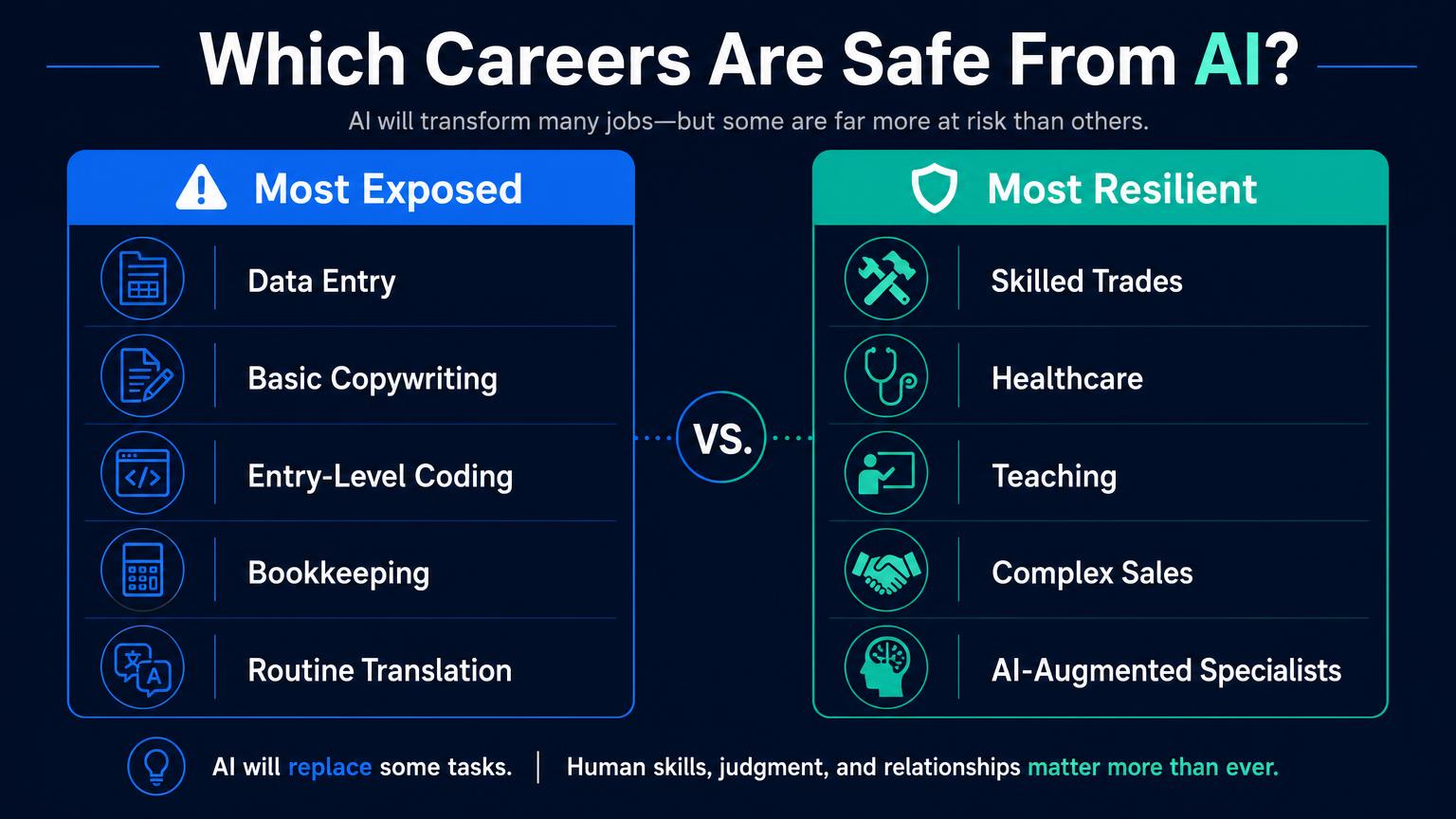
The 6 Most Exposed Types of Work
Bulk data entry and list cleaning
Structured, repetitive, easy to verify by rule. This is the clearest automation case that exists.
Commodity first-draft copywriting
Product descriptions, meta text and generic blog filler are produced faster by a model with a decent brief.
Routine translation and transcription
Good enough quality at near-zero cost. Specialist, legal and literary translation still needs humans.
Basic bookkeeping and reconciliation
Rule-driven matching. Advisory accounting and anything requiring sign-off stays human.
Tier-one scripted support
Scripted answers were the first thing chatbots did well. Escalation and de-escalation are not scripted.
Template-driven design and entry-level tickets
Resizing, formatting and boilerplate code are now a prompt. Systems thinking and taste are not.
If you recognise your week in that list, treat it as a timer rather than a verdict. The people who came out of this well were mostly the ones who moved a year early.
The 6 Most Resilient Careers
Skilled trades
Electricians, plumbers, HVAC, machinists. Physical, non-standard environments plus liability. Demand is rising, not falling.
Healthcare and care work
Diagnosis assistance is real, but treatment, touch, consent and responsibility remain with licensed people.
Teaching and training
AI is a brilliant tutor and a terrible motivator. Attention, pacing and accountability are human work.
Complex and high-value sales
Multi-stakeholder trust, negotiation and reading a room. AI prepares the deal, a person closes it.
Operations, logistics and site leadership
Constant exceptions, physical constraints and fast judgement calls under incomplete information.
AI-augmented specialists in any field
The safest category of all: your existing expertise plus fluency with the tools. This one is available to everyone reading.
Notice the common thread. Resilience comes from consequences. Where a wrong answer costs money, health, safety or a relationship, organisations keep a human on the hook, and that human uses AI as an instrument.
The 4-Question Exposure Test
Score your own role honestly. Each "yes" pushes you toward the exposed side:
- Is the output mostly text, data or a template? Physical and relational work is far harder to automate.
- Could a competent stranger do it from written instructions alone? If yes, so can a model.
- Is it repeated at volume with light review? Volume plus low stakes is the automation sweet spot.
- Does anyone need to be accountable for it by name? If nobody has to sign, nobody has to be human.
Three or four yeses means restructure your week now. One or two means you are safe from replacement but not from being out-paced.
The AI-Proof Skill Stack
The good news is that the protective skills are boring, specific and learnable. They stack in this order.
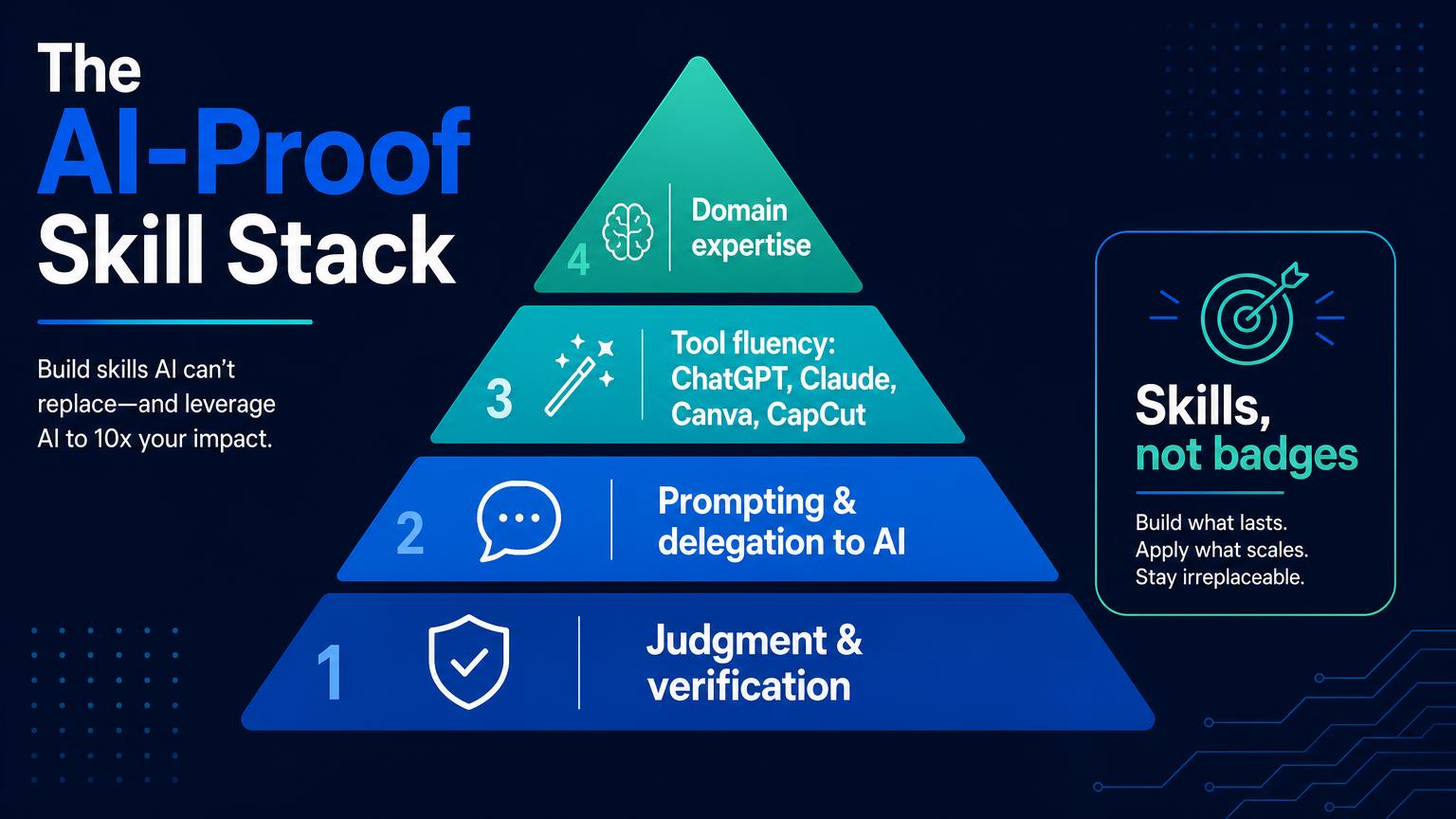
- Judgement and verification | the ability to look at fluent output and know it is wrong. This is the scarcest skill in the market right now and the one employers pay for.
- Prompting and delegation | briefing a model the way you would brief a capable new hire: role, task, context, format, constraints. Covered step by step in How to Use ChatGPT Effectively.
- Tool fluency | actually knowing ChatGPT, Claude, Canva and CapCut well enough to reach for the right one without thinking. Fluency, not familiarity.
- Domain expertise | the layer that makes all of the above valuable. Generic AI skills are cheap, AI skills applied to a field you understand deeply are not.
Two habits sit across all four: keep your best prompts instead of retyping them, which is the case for a prompt vault, and check your employer's policy before you paste anything sensitive, which is covered in How to Use AI at Work.
A 30-Day Plan to Move Sides
- Week 1 | audit. List every recurring task in your week and mark each one automatable, assistable or human-only. Most people find 30 to 50% assistable.
- Week 2 | delegate three. Pick the three most tedious assistable tasks and build a reusable prompt for each. Save them. Measure the time saved.
- Week 3 | verify. Build a checking routine: sources, numbers, names, claims. Being fast and wrong is worse than slow and right.
- Week 4 | show it. Turn your workflow into something visible, a template your team uses, a report you now produce weekly, a portfolio piece. Employability comes from evidence.
Want the same thing as a structured learning path rather than a self-directed month? That is the four-week roadmap.
4 Myths Worth Dropping
- "Creative work is safe." Commodity creative is the most exposed work there is. Distinctive creative with a point of view is not.
- "Technical work is safe." Entry-level coding tickets were among the first to be automated. Systems design was not.
- "A certification protects me." It signals interest, not capability. See the data on AI certifications.
- "I will learn it when I have to." By then the differentiator has moved from using AI to using it well, and you are starting a lap behind.
The Shortcut: Learn the Layer That Pays
Market Me Global teaches the applied layer, no coding and no theory detours, so the skill stack above becomes a real weekly workflow:
- Chapter 1 | Best AI Tools for Beginners | the tools, the prompting workflow, your first real outputs.
- Chapter 2 | Using AI to Increase Productivity | turning prompts into repeatable weekly workflows.
- Chapter 3 | AI for Social Media, Captions and Posts | ultra prompts, templates and advanced builds.
Every account gets 3 free minutes of each chapter every month, no card required, so you can judge it before you spend anything. Top up whenever you want more.
Frequently Asked Questions
Which careers are safest from AI?
Careers that combine physical presence, accountability and human trust are the most resilient: skilled trades, healthcare and care work, teaching, complex or high-value sales, operations and logistics leadership, and any role where a licensed human has to sign off on the decision. AI can assist all of them, but it cannot be held responsible for them.
What jobs will AI replace first?
The pattern is tasks, not job titles. The most exposed work is repetitive, text or data based, produced at volume and reviewed lightly: basic data entry, first-draft copy at scale, routine translation, simple bookkeeping, template-driven design, entry-level coding tickets and tier-one support scripts. Roles built almost entirely from those tasks shrink first.
Will AI take my job or just change it?
For most people it changes the job. AI absorbs the drafting, sorting and summarising, and what remains is briefing, judgement, verification and relationships. The risk is not that a model replaces you, it is that a colleague who delegates well to a model does the work of three people.
What skills make you AI-proof?
Four layers, in order: judgement and verification, prompting and delegation, fluency with the actual tools (ChatGPT, Claude, Canva, CapCut), and deep domain expertise in your field. Notice that only one of those four is technical, and none of them require coding.
Do I need a degree or certification to stay employable?
No. Employers hiring for AI-adjacent work are testing whether you can produce a result, not whether you hold a badge. A portfolio of real outputs, a repeatable workflow and the ability to explain how you verified the output beats a certificate almost every time.
How long does it take to become genuinely useful with AI?
Two to four weeks of daily practice on your own real tasks. Not theory, not a 40-hour video library. Market Me Global's chapters compress that into a structured path, and every account gets 3 free minutes of each chapter per month with no card required.
Is it too late to start in 2026?
No, but the free window is closing. In 2023 using AI at all was a differentiator. In 2026 it is the baseline, and the differentiator is using it well: context, verification, repeatable workflows. Starting now still puts you ahead of most of your industry.
Which career should I move into if my job is exposed?
Move sideways before you move out. Take your existing domain knowledge and add AI fluency on top of it, so you become the person in your field who ships faster. That transition is far shorter and better paid than restarting in an unrelated industry.
Key Takeaways
- AI takes tasks, not titles. Audit your week by task and the picture gets clear fast.
- Exposed work is text or data based, high volume and lightly reviewed.
- Resilient work carries consequences: physical, licensed or relational accountability.
- The most available safety is becoming the AI-augmented specialist in your own field.
- Judgement and verification are worth more than any certificate on your CV.