
AI Business · Free tools
How to Build a Digital Product in 3 Clicks Using Free AI Tools
9 September 2026 · 12 min read · by Emmanuel Abou Chabke
A digital product is a file people pay to download, such as a PDF receipt pack, a checklist, a planner or a prompt pack. With free ChatGPT or Claude you can produce the contents in one prompt, format and export it in a second step, then publish it with a price in a third. The hard part was never the making, it was choosing a narrow enough problem and putting the link somewhere buyers can see it.

Key Takeaways
- A digital product is any file someone pays to download, so a good checklist counts.
- Free ChatGPT or Claude writes the contents, Google Docs or Canva exports the file, a checkout link sells it.
- Narrow beats broad. Receipts for one trade outsell a general business bundle.
- Reported earnings run from a few hundred a month to millions, and the large numbers took years of refining one product.
- AI removes production time, not judgement. Every figure and claim still needs your review.
- Chapter 1 covers the prompting, Chapter 2 the repeatable process, Chapter 3 the promotion.
- If you would rather start from ready-made business workflows, The Small Business AI Action Kit gives you 10 workflows, 20 prompts and four fillable worksheets in one PDF.
What Counts as a Digital Product?
Anything deliverable as a file or a link, with no stock, shipping or physical cost. PDFs, spreadsheets, templates, prompt packs, guides, checklists, printables, presets and swipe files all qualify. The buyer pays for time saved and thinking skipped, which is why plain-looking documents often sell better than beautiful ones nobody needs.
Two rules keep beginners out of trouble. Solve one problem for one type of person, and make the outcome obvious from the title alone. If you cannot describe who it is for in a single sentence, the product is not ready.
Products You Can Genuinely Build Today
PDF receipts and invoice templates
Fill-in receipts, invoices, quotes and delivery notes for freelancers, salons, tradespeople and small shops. Boring, endlessly needed, and quick to produce well.
Checklists and standard operating procedures
Onboarding checklists, launch checklists, cleaning schedules, month-end finance routines. People pay to skip the thinking, not the typing.
Planners and trackers
Content planners, budget trackers, habit sheets, stock lists. A spreadsheet with clear instructions is a product.
Prompt packs
A tested set of prompts for one job, such as writing property descriptions or replying to customer emails, with instructions for each one.
Mini guides and cheat sheets
Ten to twenty pages that solve one narrow problem completely. Narrow beats broad every time.
Templates for tools people already use
Canva post sets, Google Sheets calculators, Notion dashboards, email sequence swipe files.
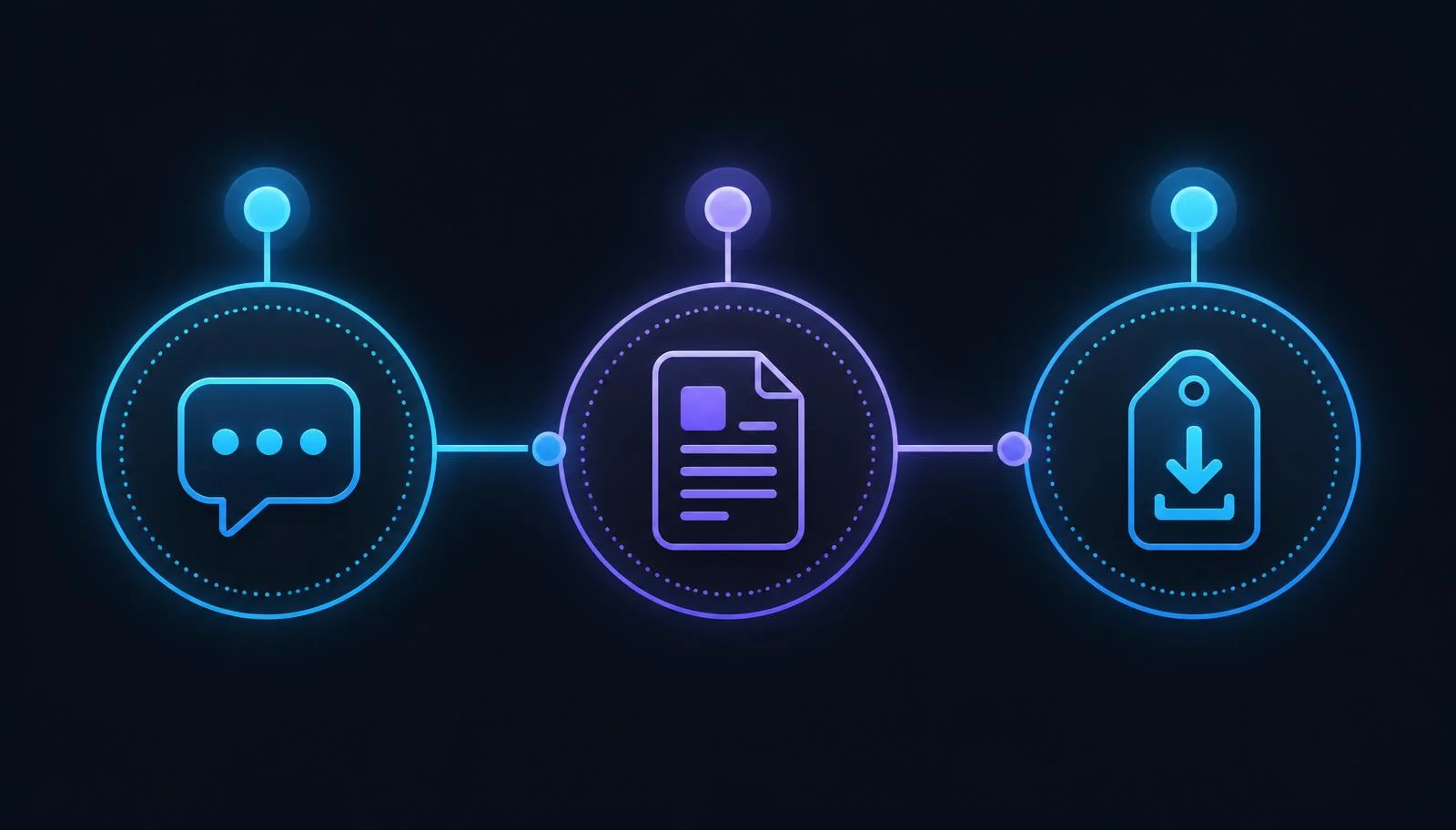
The Three-Click Method
- Click one, ask AI for the product. Open free ChatGPT or free Claude and describe one audience, one problem and one format. Ask for the full contents of the file, not a summary. You want the finished text, section by section, in the order it should appear.
- Click two, format it into a real file. Paste the output into Google Docs, Google Sheets or Canva, apply one heading style, add your name and a simple cover page, then export as PDF. Canva and Google Docs both export a clean PDF for free.
- Click three, put a price on it. Upload the file to a marketplace or checkout tool, write a short description, set a price and publish. You now have a link a stranger can pay through.
The Starter Prompt, Free to Copy
Paste this into free ChatGPT or free Claude, replace the words in brackets, and read the output critically before you sell anything based on it.
You are helping me create a digital product I will sell. Audience: [type of person, for example independent hairdressers in Cyprus]. Problem: [the exact task they hate]. Format: [PDF pack, spreadsheet, checklist]. Write the complete contents, not a summary: a cover page title, a one-page how to use this, then every page or section in order with all the wording filled in. Keep the language plain, avoid claims you cannot support, and flag anything I must check myself, such as tax, legal or pricing details. Finish with a 60-word product description and five short social captions I can use to sell it.
The last line matters as much as the first. If the model tells you which parts need checking, you know where the risk is. Building prompts that behave like this is exactly what prompt engineering means in practice.
A Worked Example: A PDF Receipt Pack
Say you sell a receipt and invoice pack for small service businesses. The prompt produces a cover page, a usage page, a numbered receipt layout, an invoice layout, a quote layout, a deposit slip and a simple annual income sheet. You paste it into Google Docs, apply one heading style, add a clean cover in Canva and export a PDF.
Then you check the parts a model cannot be trusted with: the tax wording, the fields your country expects, the numbering rules and anything that reads like legal advice. That review pass is the difference between a product and a refund. Once it is right, the same file can be re-skinned for a second trade in under an hour, and that is how a single product quietly becomes a small range.
Real People, Real Numbers
These are publicly reported figures from named sellers, linked so you can read the original accounts. They are outliers, self-reported, and not a prediction of what you will earn. They are useful because they show the shape of the thing: narrow products, sold repeatedly, improved over years.
| Seller | Product | Reported figure | Why it worked |
|---|---|---|---|
| Thomas FrankBuilt by Foundry | Notion productivity templates for creators | Around $2.1M in template sales in roughly two years, reported near $120K a month at peak | One narrow audience, one flagship template, refined for years |
| Sam Vander WielenCreator Science | Fill-in-the-blank legal contract templates | Over $8M lifetime from essentially one product, close to $2M a year | A painful, specific problem, sold through one evergreen funnel |
| Oliur, PlatSupplyoliur.com | An AI-generated wallpaper pack, made in one afternoon | Over $40,000 to date | AI did the production, taste and audience did the selling |
| Ramish, Studio NotesStartup Founder Stories | Framer website templates | About $32K in his first full year, roughly $6K a month recurring | Templates for a tool with a growing user base and few good options |
| An indie developer selling Notion dashboardsThe Indie Hacker Podcast | Free templates as the funnel, paid dashboards as the product | About $10K a month from roughly 520 sales a month after six months | Free versions removed all friction, paid versions did the earning |
Below the headline cases sit thousands of smaller ones. Published first-year accounts from creators using ChatGPT plus a checkout tool commonly report a few hundred dollars in the first month and somewhere in the low thousands per month by the end of the first year, and plenty report nothing at all. That range, not the millionaire figure, is the honest planning number for a first product.
What Those Cases Have in Common
- A narrow audience. Creators, lawyers of one type, users of one specific tool. Never everyone.
- One product, improved repeatedly. Not ten products launched once each.
- A traffic channel they already owned. YouTube, search, a mailing list, a marketplace with buyers in it.
- A free version doing the marketing. Free templates removed the friction, paid versions carried the revenue.
- AI used for speed, not for the idea. The judgement about what to sell stayed human.
Where to Sell It
A marketplace
Etsy and similar marketplaces already have buyers searching for templates and printables, so your first sales can come from search rather than from an audience you do not have yet.
A creator checkout tool
Gumroad, Lemon Squeezy, Payhip and Stripe payment links host the file, take the payment and deliver the download. Fees and features change, so compare on the day you publish.
Your own social bio
One link, one product, one pinned post explaining who it is for. This is where Chapter 3 pays for itself.
Direct to people who already asked
The fastest first sale is usually a person who complained about the exact problem last week. Send it to them at a fair price and ask what was missing.
Whichever route you pick, the listing does the selling. One clear title naming the buyer, three lines on what is inside, an honest preview image and a price that does not require a decision. The captions and short videos that drive people to it are covered in how to use AI in marketing.
How the Academy Chapters Teach Each Part
- Chapter 1, Best AI Tools to Use Today. The prompting structure that gets complete, usable output from ChatGPT and Claude instead of vague summaries, plus which tools are worth your time.
- Chapter 2, Using AI to Increase Productivity. Turning a one-off file into a repeatable process: documents, reports, presentations, automation and content repurposing.
- Chapter 3, AI for Social Media, Captions and Posts. The part most people skip. Captions, carousels, short video and product promotion so the link actually gets seen.
Students get the private portal, the prompt package used in the lessons, downloadable slides, saved notes, progress tracking, lifetime access to the chapters they buy and a personalised Certificate of Achievement. There is a free monthly preview if you want to judge the teaching before paying for anything.
Learn the Prompting That Makes This Work
The prompt above is the short version. Chapter 1 shows the full structure on screen, with the prompt pack included, so your first draft is close to sellable instead of close to generic.
Mistakes That Kill a First Product
- Too broad. A general productivity bundle competes with everything. A receipt pack for one trade competes with almost nothing.
- Shipping unchecked AI output. Wrong tax wording or invented figures cost you refunds and trust.
- Overbuilding. Twelve pages that solve one problem beat ninety that solve none.
- No preview. Buyers need to see two pages before they believe the rest exists.
- Silence after launch. Publishing is not promotion. Something has to point at the link every week.
- Copying another paid product. Asking a model to imitate someone else's file is theft with extra steps.
Frequently Asked Questions
Can you really build a digital product in three clicks?
Three steps, and each one is genuinely one action: ask AI for the contents, paste and export the file, then publish it with a price. The clicking is the easy part. Choosing the right narrow audience and checking the output for accuracy is the work that decides whether it sells.
Can I do this with free ChatGPT or free Claude?
Yes. The free tiers of ChatGPT and Claude write the contents, structure the sections and draft the sales description. Google Docs, Google Sheets and Canva all export a clean PDF at no cost. You can publish a first product without paying for any tool.
What is the easiest digital product to start with?
A PDF receipt, invoice or checklist pack for one specific trade. It is short, quick to make, easy to check for errors and solves a problem people already know they have, which makes the description almost write itself.
How much can you realistically make selling digital products?
Most first products make a handful of sales, and published first-attempt accounts commonly land somewhere between a few hundred and a few thousand a month within the first year. The very large figures reported by creators like Thomas Frank and Sam Vander Wielen come after years of audience building and repeated refinement of one product. Treat those as what is possible, not what is likely, and nothing here is a promise of income.
Do people actually buy AI-generated products?
They buy solved problems. Oliur made over $40,000 from an AI-generated wallpaper pack he built in an afternoon, because the packaging, taste and audience were his. Products that are obviously unchecked AI output do badly, which is why the review pass matters more than the generation.
How should I price a first digital product?
Small and simple. A single template pack usually sits low enough to be an impulse purchase, and a bundle of several sits higher. Start where a buyer does not need to think, learn from the questions you get, then raise the price as the product improves.
Do I need to disclose that I used AI?
Be honest if asked, never claim a human wrote something a model produced, and never copy someone else's paid product through a model. Check every fact, figure and legal statement yourself, because you are the one responsible for what you sell.
Which Academy chapter teaches this?
Chapter 1 teaches the prompting and tool choices that produce a usable draft. Chapter 2 turns it into a repeatable process with automation, documents and reporting. Chapter 3 covers the social content, captions and short video that get the product in front of buyers.
Build the First One This Week
About the author
Emmanuel Abou Chabke is the founder of Market Me Global and the instructor of the Academy chapters. He tests AI tools on client work first, then teaches only the small stack that holds up at a sensible cost.
Earnings figures quoted above are publicly reported by the sellers named and linked. They are examples, not projections, and nothing on this page is a promise of income or financial advice.