AI Courses · Buyer's guide
Best AI Courses in 2026 (Google, Coursera and the Free-First Alternatives)
August 30, 2026 · 10 min read · by Emmanuel Abou Chabke
Nearly ten thousand people a month search for "AI courses" in the US alone, and most of them land on a page that lists forty options without helping them choose one. This guide does the opposite. Four formats, what each one is genuinely good at, where each one wastes your money, and five filters that make the decision in about ten minutes.
Quick Answer
If you need a recognised name on your CV, take a big-tech certificate. If you want to understand how models work under the hood, audit a university MOOC for free. If you are changing careers into technical AI work, a bootcamp buys accountability. And if you simply want to be visibly better at your current job within two weeks, take an applied practical course built on real tasks, and start with a free trial rather than a subscription.
The Four Formats Compared
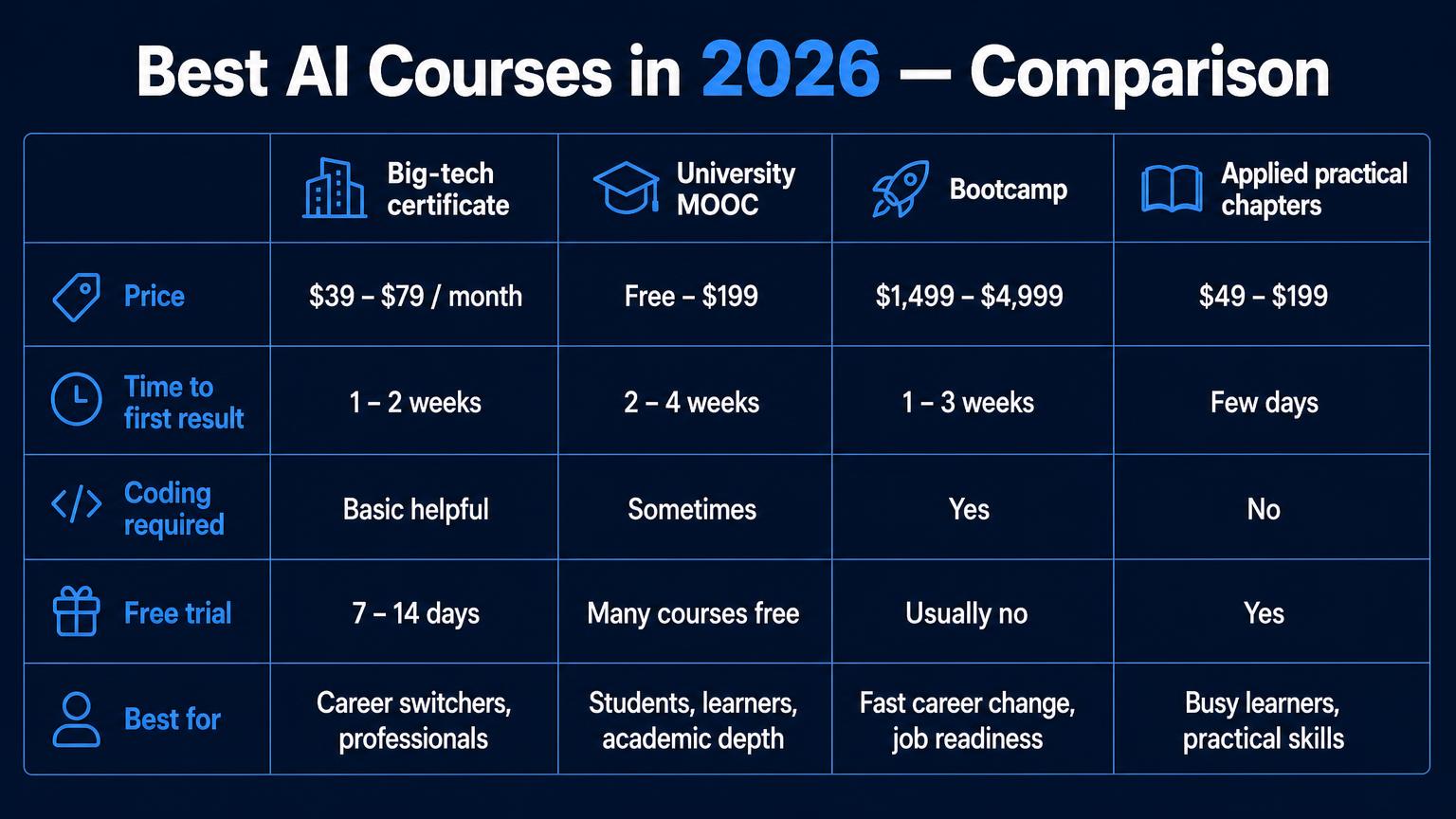
Every AI course on the market is a variation of four formats. Prices move, the trade-offs do not. Figures below are typical ranges rather than any single provider's current pricing, so check before you buy.
| Format | Typical price | Coding | First useful result |
|---|---|---|---|
| Big-tech certificate | Monthly subscription | Helpful, not required | 1 to 2 weeks |
| University MOOC | Free to audit, paid certificate | Often required | 2 to 4 weeks |
| Bootcamp | Four figures | Required | 1 to 3 weeks |
| Applied practical chapters | Low, pay per chapter | None | Days |
What Each Format Is Really For
Big-tech certificates
Best for: Career switchers who need a recognised name on the CV.
Strengths: Strong brand signal, well-produced, structured assessments, often a short free trial.
Watch out: Product-centric, subscription pricing, and the badge arrives long before a usable weekly workflow does.
University MOOCs
Best for: Learners who want the concepts underneath the tools.
Strengths: Genuine academic depth, usually free to audit, excellent for understanding how models work.
Watch out: Maths and coding assumptions, low completion rates, and very little about the tools you will open tomorrow.
Bootcamps
Best for: People making a full career change into technical AI work.
Strengths: Live cohorts, accountability, projects and sometimes career support.
Watch out: Four-figure prices, fixed schedules, and far more curriculum than a non-technical role needs.
Applied practical chapters
Best for: Busy professionals who want results on their own real tasks first.
Strengths: No coding, short chapters, prompt templates, immediate outputs, free minutes before you pay.
Watch out: It is not a substitute for a computer-science education if your goal is to build models.
Notice that none of these are competitors in the strict sense. A MOOC and an applied course teach different things, and plenty of people do both. What wastes money is buying the wrong one for the outcome you wanted.
5 Filters for Choosing
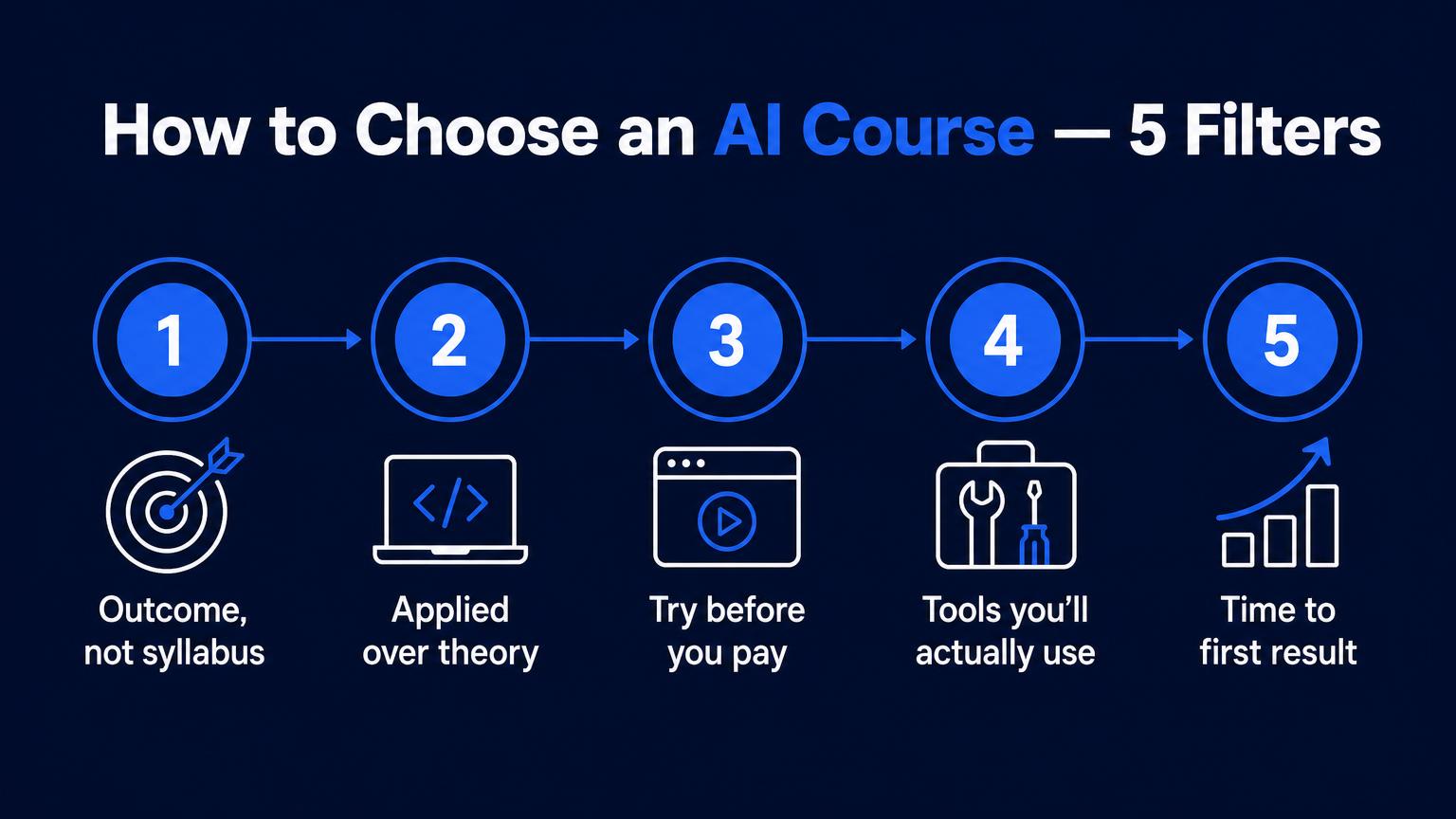
- Outcome, not syllabus | Ask what you will be able to do at the end, in one sentence. If the answer is a topic list rather than a capability, keep looking.
- Applied over theory | Theory is free and abundant. What is scarce is a course that makes you practise on your own real tasks with feedback loops.
- Try before you pay | Any course confident in its teaching lets you sample it. Use the free window to judge pacing, clarity and whether it respects your time.
- Tools you will actually use | Check the tool list against your week: ChatGPT, Claude, Canva, CapCut and a prompt library beat an exotic stack you will never open again.
- Time to first result | The best predictor of finishing a course is producing something useful early. Days is good, weeks is acceptable, never is common.
If a course fails filter three, treat that as the answer. Confidence in your own teaching looks like a free sample, not a longer sales page.
Where the Genuinely Free Options Are
- Audit a MOOC. Most platform courses let you watch everything free and charge only for graded assessments and the certificate.
- Big-tech intro paths. Google, Microsoft and others publish free foundational generative AI modules, useful for vocabulary and concepts.
- Vendor documentation. The official ChatGPT and Claude guides are free, current and better than most paid summaries of them.
- Our free minutes. Every Market Me Global account gets 3 free minutes of each chapter every month, no card required, so you can test the teaching before spending.
Free study fixes vocabulary. It rarely fixes habit. Pair anything free with a rule that you apply it to one real task the same day, which is the whole idea behind using AI at work.
5 Expensive Mistakes
- Buying the longest course. Length is not depth. Completion rate matters more than hours of video.
- Chasing a badge before a skill. See the data in which countries search most for AI certifications.
- Starting with model theory. Fascinating, but it will not make tomorrow's report faster. Get the layers straight quickly in AI vs machine learning vs deep learning.
- Learning tools you will never open. Match the syllabus to your actual week.
- Not saving your prompts. You will rebuild the same brief twenty times. Build a prompt vault instead.
Where Our Chapters Fit
Market Me Global sits firmly in the applied column. No coding, no theory detours, short chapters built around the tasks non-technical people actually have:
- Chapter 1 | Best AI Tools for Beginners | the tools, the prompting workflow, your first real outputs.
- Chapter 2 | Using AI to Increase Productivity | turning prompts into repeatable weekly workflows.
- Chapter 3 | AI for Social Media, Captions and Posts | ultra prompts, templates and advanced builds.
Prefer a step-by-step study plan first? Start with the four-week roadmap or the beginner buyer's guide.
Every account gets 3 free minutes of each chapter every month, no card required, and you can top up whenever you want more.
Frequently Asked Questions
What is the best AI course in 2026?
There is no single best AI course, there is a best course for your goal. If you want a recognised badge, a big-tech certificate is the strongest signal. If you want academic depth, a university MOOC is better. If you want to be using AI well inside two weeks on your own real work, an applied practical course is the fastest route. Match the format to the outcome you actually need.
Are there free AI courses worth taking?
Yes. Most university MOOCs can be audited for free, several big-tech learning paths are free to study and only charge for the certificate, and Market Me Global gives every account 3 free minutes of each chapter every month with no card required. A free first hour is the cheapest way to find out whether a course teaches or just talks.
Does Google have a free AI course?
Google publishes free introductory AI and generative AI learning paths, and its professional certificates are paid but usually include a short free trial. They are strong on concepts and Google's own products. They are lighter on the day-to-day habit of briefing a model, verifying its output and turning that into a repeatable weekly workflow.
Do I need to know how to code to take an AI course?
For applied courses, no. Prompting, verification, tool fluency and workflow design require no code at all. Coding only becomes necessary if you want to build models or ship AI features as a developer, which is a different career path from using AI well in an existing job.
How long should an AI course take?
Look for a first useful result in days, not months. A good applied course produces something you can show after the first session. A 40-hour video library that produces nothing until week six is usually a completion problem disguised as a curriculum.
Is an AI certificate worth it?
A certificate signals interest, a portfolio proves capability. Certificates help most when a hiring process filters on them. Beyond that, employers ask what you have produced and how you checked it, which is why we push learners toward outputs first and badges second.
Which AI course is best for marketers and business owners?
Pick one built on marketing and operations tasks rather than on theory: prompting for ad copy, content repurposing, research briefs, image and video tools, and weekly workflows. Our Chapter 1 to Chapter 3 path is built exactly that way, with no coding and no theory detours.
How much should an AI course cost?
Applied courses reasonably sit in the tens rather than the thousands. Bootcamps charge four figures because of live cohorts and career services. Before paying anything, use a free trial to confirm the teaching style suits you, then top up only for the chapters you want.
Key Takeaways
- There is no best AI course, only the best format for your goal: badge, depth, career change or applied speed.
- Big-tech certificates buy recognition, MOOCs buy understanding, bootcamps buy accountability, applied courses buy speed.
- Free options are plentiful, from audited MOOCs to our 3 free minutes per chapter each month.
- Judge a course by time to first useful result, not by hours of content.
- If you cannot sample it before paying, that is information about the course.