
Play along
Movement games
The screen gives you an action to copy or a shape to match. The appeal is a short, visible task inside a game-like story.
Creator Features | Immersive Experiences
| 8 min read
By Emmanuel Abou Chabke, founder of Market Me Global and KinetiRift
One moment there is a wall shape to match. Another, the view is a sunset route through Paphos. In a third, you can turn your view towards the Mediterranean instead of following the camera straight ahead. KinetiRift brings these experiences into one library, but they ask very different things of the viewer.
This is a guide to choosing what to try, not a game-building tutorial. The interesting question is whether you want to act inside a story, watch somewhere you might like to visit, or look around an immersive scene. Once you make that distinction, the category names become useful rather than just another list of videos.
KinetiRift’s official About page introduces it as a Market Me Global project founded by Emmanuel Abou Chabke, built around giving viewers something to do inside a story. That connection is worth making explicit here: I am writing about a project I founded, not offering an independent review of an unrelated channel.
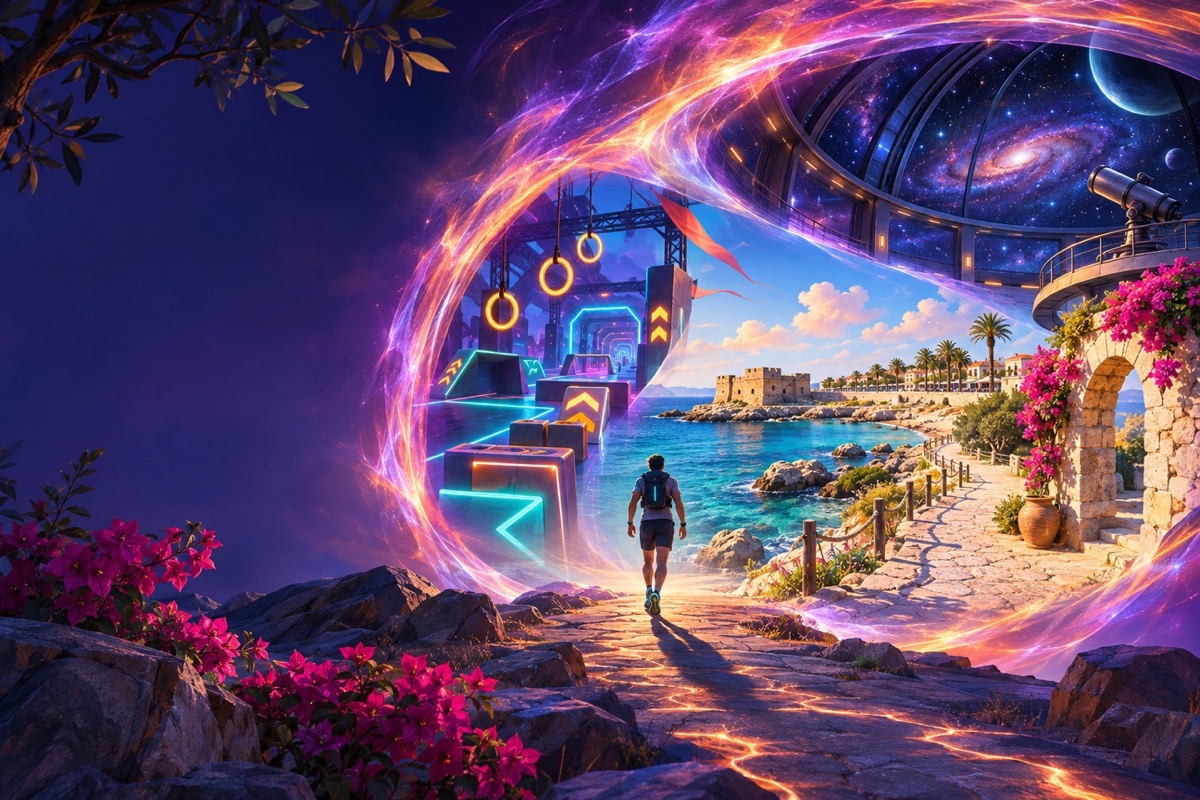
Its library spans cinematic obstacle games, dance and pose challenges, filmed Paphos walks and 360° experiences. The common thread is a sense of entering a setting. The mechanism changes: a cue invites movement, a coastal route gives you a place to watch, and a 360° scene lets you choose where to look.
These are videos, not a promise that software is detecting your body or awarding a measured score. The official movement collection explains that YouTube plays a fixed sequence of cues, without a camera or motion sensor. You participate in the idea of the challenge while the recorded sequence continues.
Play along
The screen gives you an action to copy or a shape to match. The appeal is a short, visible task inside a game-like story.
Follow a route
The view follows real Paphos scenery. Choose this for the route, the coast and the changing light, rather than a boss or a pose challenge.
Look around
The view surrounds you, and a supported player lets you change direction. The featured Paphos episode brings that format to filmed coastal scenery.
“Immersive” is not a guarantee of a headset format. A fixed-view movement game may feel involving because the story gives you a role. A 360° walk is different because you can look away from the route’s forward direction. Likewise, a standard virtual walk is not automatically stereoscopic 3D. Check the individual episode description before deciding how to play it.
The examples below correspond to the eight public category names in KinetiRift’s official video library. Each opens the named YouTube episode; category captions explain the starting point rather than making a claim about results.
Paphos, Cyprus in 360° | 25-Minute Coastal VR Walk (4K)
360° & VR | Look around a filmed Mediterranean coastal route.
Paphos, Cyprus at Sunset | 28-Min Virtual Walk
Cyprus Walks | A sunset route with a stabilized forward view.
64 NEW POSES! Can You Beat the Twins? | Human Tetris 2 Player Challenge
Human Tetris | Match the wall shapes, solo or with a partner.
Can You Beat the Prism Boss? | Immersive Interactive Warm Up
Rhythm | Move through four dimensions towards a final boss.
Don’t Trust the Smile! | VERITY 4: The Puppet Clock
Horror Workouts | A suspense-led movement story, not a scenic tour.
The 25-minute coastal VR walk is filmed in 4K 360°: you can look towards rocky coves, seaside homes, the waterfront and breakwaters. The sunset walk takes a stabilized route-based approach. Pick the first if changing your viewing direction is the attraction; pick the second if you want the camera’s forward journey. Neither requires you to copy movement cues.
The Twins challenge asks two sides to fit approaching wall shapes, with 64 distinct poses across 32 walls. Its official description allows solo play on either side or a partner. It is a clear visual matching task: your attention goes to the outline and your next pose, not to following a geographical route.
The Maglev Train episode puts switching and dodging inside a rescue premise. This category suits a viewer who likes the idea of moving forward through a route with decisions appearing on screen. It remains a play-along video: your movement does not change which recorded scene appears next.
Egyptian Drum Duel gives the viewer a watch-and-copy rhythm. Its official description says to watch each eight-second dance phrase and repeat it when YOUR TURN appears. That call-and-response structure is a different starting point from a wall arriving or an obstacle to dodge: you first observe an example, then mirror it.
The featured Monster Sports Showdown moves through baskets, goal saves, boxing, volleyball and rowing cues before a championship mash-up. It sits in Escape & Obby even though this episode uses sports rather than a literal escape route. Choose by the episode description as well as the collection label.
Prism Boss combines spell casting, dance copying, a Moon run and wall poses across four dimensions. Its official page describes a roughly 13-minute sequence ending with a boss. If you want several action types inside one story rather than one repeated challenge, it offers a useful contrast with Human Tetris or the short dance example.
VERITY 4: The Puppet Clock uses suspense as its story frame. That is a reason to preview the episode before choosing it, especially for a shared viewing session. A viewer looking for coastal scenery or a straightforward copy-the-shape game should not treat the horror category as an interchangeable substitute.
Start with a preference, not a ranking. Do you want to watch a place, move to cues or explore the view? Then use duration and mood to narrow the choice. The short Twins challenge and Egyptian Drum Duel introduce specific mechanics; the Paphos examples offer a longer route to settle into.
| Your preference | Try | What to check |
|---|---|---|
| Scenery without movement cues | Cyprus sunset walk | A standard route view is what you want. |
| Look to either side of the coast | Paphos 360° walk | A supported player or compatible VR setup. |
| A clear visual task | Human Tetris | Solo side or partner, plus room to move. |
| Copy a short sequence | Egyptian Drum Duel | The watch-then-repeat structure. |
| A story with varied actions | Prism Boss or Monster Sports Showdown | The cue types and episode length. |
| A suspense-led setting | VERITY 4 | Preview the mood before a shared session. |
For an easier first movement-game entry, the official collection suggests Human Tetris EASY or a short train escape. The 64-pose Twins example here demonstrates the category; it is not a claim that every viewer should begin with that particular challenge.
For the movement categories, KinetiRift recommends a screen visible from a comfortable distance and enough clear room to step and reach. Its official guidance says no controller or headset is needed. You can follow at your own pace, pause, skip a move or choose a step instead of a jump. The Prism Boss page specifically describes playback on a TV or screen.
For a standard Cyprus walk, the collection describes stabilized tours for a TV or treadmill. That tells you the intended viewing format, not that you must walk while watching. The same collection distinguishes its stereoscopic Venus Beach edition from a standard TV video; a title containing “virtual walk” alone does not establish 3D compatibility.
For the featured Paphos coastal 360° episode, the official watch page recommends YouTube VR on a compatible headset and seated viewing. On a phone, it describes swiping in the YouTube app; on a supported desktop browser, clicking and dragging to look around. Open the YouTube version if your current player does not offer those controls. Device and connection affect playback quality.
These are format and viewing notes drawn from KinetiRift’s own pages, not medical advice or promises about calories, fitness, weight loss or other health outcomes.
A useful creator question is: what gives the viewer a role? It might be a shape to match, a turn to copy or a world to look around. You can notice that design choice without assuming how a particular video was produced.
If you want to learn to build your own AI-assisted game experiences, the Academy’s AI Game Creator Kit is a separate learning resource. You do not need to buy it to explore KinetiRift. Our earlier game-creation tutorial covers the building workflow; this feature stays focused on the video formats and the viewer’s starting point.
Explore the creator kitKinetiRift is a Market Me Global project founded by Emmanuel Abou Chabke. Its public video library combines play-along movement games, filmed walks around Paphos in Cyprus and 360° experiences.
No. KinetiRift describes a fixed sequence of YouTube video cues that viewers follow at their own pace, without a camera or motion sensor. The story responds on screen as part of the video, not because it has measured your movements.
Not for the play-along movement games or standard Cyprus walks. For the Paphos 360° walk, KinetiRift recommends YouTube VR on a compatible headset while seated. You can also swipe in the YouTube mobile app or click and drag in a supported desktop browser.
KinetiRift says its Cyprus walk collection was filmed around Paphos. The featured 25-minute coastal 360° walk is filmed footage too. Other experiences in the broader 360° collection use virtual environments, so check each episode description rather than treating every scene as a filmed location.
Choose a standard Cyprus walk if you want scenery, a Human Tetris video if you like matching visible shapes, or the Paphos 360° walk if you want to look around the coast. Preview the chosen episode and use its official description to check the format and setup.
Keep your first choice simple. Open the official episode description, check whether it is a movement game, a standard walk or a 360° video, and try a short preview. Notice whether you want to copy cues, watch the route or control the viewing direction. These are different experiences, not different difficulty levels of the same game.
For a scenery-first evening, preview the Paphos sunset walk on a screen. If you would rather look to either side of the coast, open the Paphos 360° episode in a supported desktop browser and drag the view. If the appeal is doing something inside a story, preview Human Tetris and follow one side’s shape cues instead.
No. A play-along movement video can feel immersive because it places you inside a story while keeping a fixed screen view. A 360° video lets you change where you look. Check the category and episode description to tell them apart.
Continue with KinetiRift’s official video library to put this guide into practice.
Library categories, video IDs, episode descriptions and viewing advice checked on 24 November 2026. Titles in the carousel use the supplied editorial wording; official pages may also display emoji or longer subtitles. This is a founder-written format feature, not an independent benchmark. It makes no claim about AI being used to produce the featured videos.