
Education · Honest Take
Is AI Bad for Education? An Honest Look at the Risks in 2026
September 1, 2026 · 9 min read · by Emmanuel Abou Chabke
We sell AI lessons, so you would expect us to say AI is wonderful for learning. It is not that simple. There are four real ways AI damages education, and pretending otherwise is how students end up confident and unprepared. Here is the honest version: what actually goes wrong, what the concern gets wrong, and the study loop that keeps the thinking where it belongs.
The Short Answer
AI is bad for education when it replaces thinking, and good for education when it pressures thinking. That single line resolves most of the argument. A student who asks a model to write the essay has outsourced the learning. A student who writes the essay and then asks the model to attack its weakest argument has just bought themselves feedback they would otherwise wait a week for, or never get.
The uncomfortable part for schools is that the difference is invisible in the finished document. Both students hand in clean text. Only one of them can defend it out loud. That is why the useful response is not detection, it is assessment design and habit design.
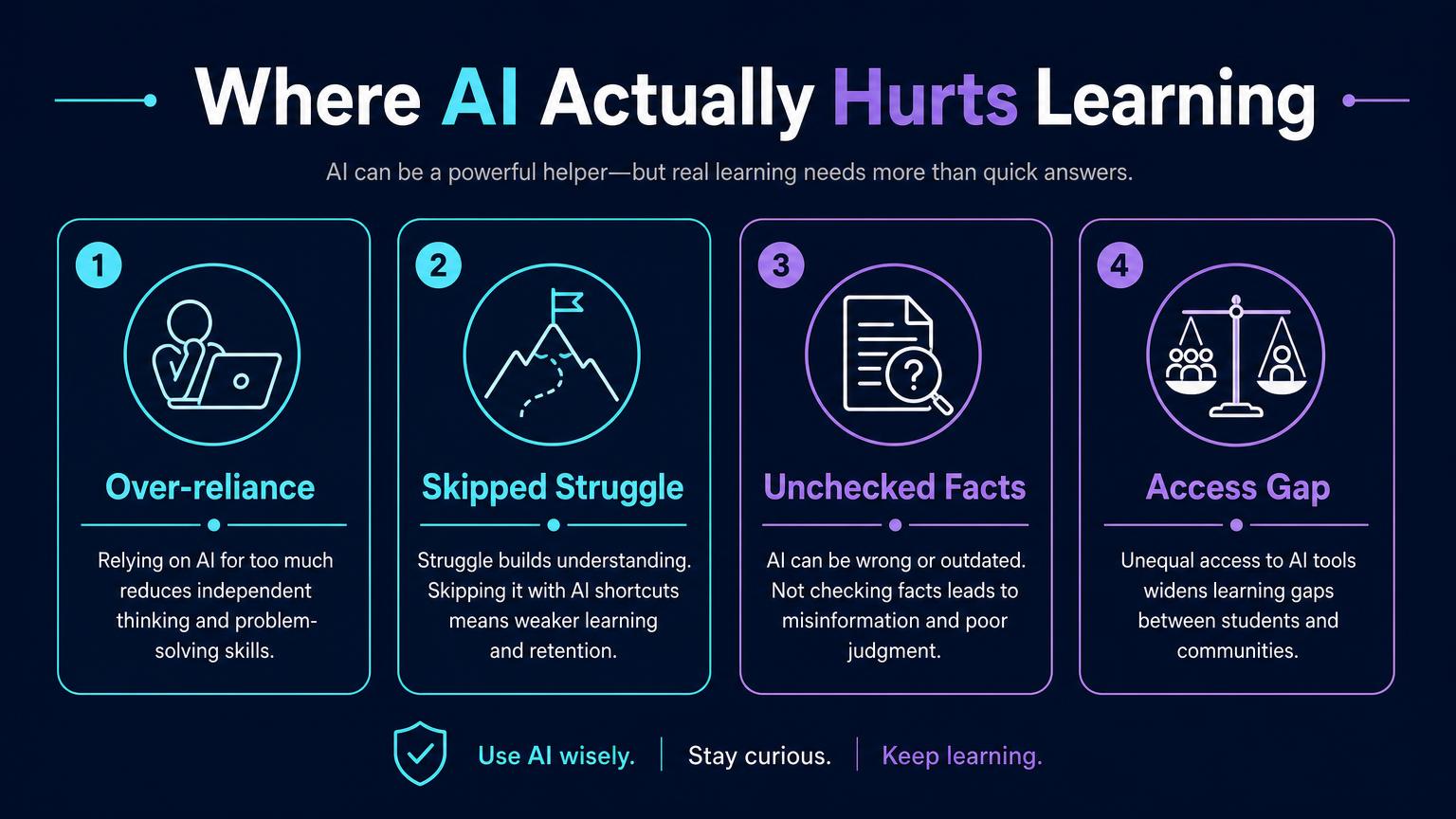
The Four Real Risks
1. Over-reliance
The strongest concern in the research. When AI supplies the answer before any attempt, students report higher confidence and lower recall. Confidence without retention is the worst combination for exams and for work.
Rule: no AI until you have written something, however bad. The attempt is what makes the explanation stick.
2. Skipped struggle
Difficulty is not a bug in learning, it is the mechanism. Retrieval practice and effortful problem solving are what move knowledge into long-term memory. A frictionless answer removes exactly the part that was doing the work.
Rule: ask for a hint, not a solution. Say what you tried and where you got stuck.
3. Unchecked facts
Models still produce confident, well-formatted errors: invented citations, wrong dates, plausible statistics with no source. In an academic context that is not a small mistake, it is the whole grade.
Rule: no fact, quote, number or citation gets used until you have seen it on a primary source.
4. The access gap
Paid tiers, faster models and better devices are not evenly distributed. Left alone, AI widens an existing gap between students who can afford the good version and students who cannot.
Rule for institutions: standardise on a tool everyone can reach, and teach the free tier properly rather than assuming a subscription.
Notice what is not on that list: "AI makes students lazy". Laziness is not a property of a tool. Every one of these risks is a specific, fixable sequencing problem, and each has a rule that costs nothing to adopt.
Cheating, Detectors and What to Do Instead
The cheating panic is real but misdirected. AI detectors are unreliable, and they misfire most often on non-native English writers, which turns an integrity tool into an unfairness engine. A detector score is a reason to talk to a student, never evidence on its own.
What holds up instead:
- Process evidence. Drafts, version history and notes are far harder to fake than a final document.
- Oral defence. Two minutes of questions reveals in seconds whether the understanding is there.
- In-room work. Move a portion of the grade back into supervised conditions, and let homework be practice.
- Personal grounding. Ask for work tied to the student's own data, fieldwork, interviews or context, which a general model cannot invent credibly.
The Responsible AI Study Loop
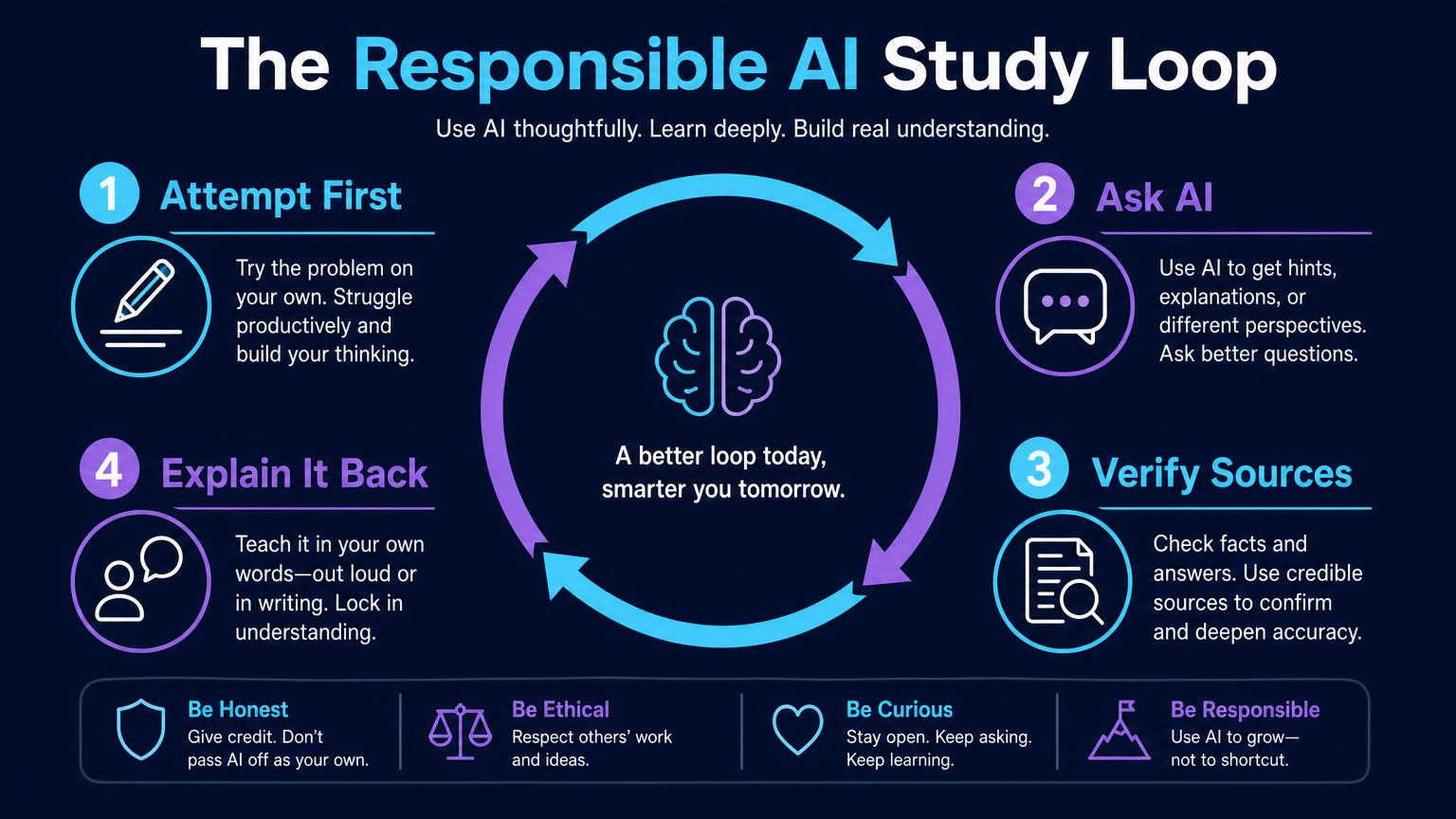
- Attempt first | produce something of your own, even a bad outline. This is the step that makes everything after it stick.
- Ask for a hint, not an answer | say what you tried and where you stalled. "Explain why my second step is wrong" beats "solve this".
- Verify | every name, date, number and citation gets checked on a primary source before it enters your work.
- Explain it back | close the tool and say the answer out loud in your own words. Cannot do it? You have not learned it, so run the loop again.
Three prompts that fit this loop, in order: "Here is my attempt, do not correct it yet, ask me three questions that expose what I misunderstood." Then: "Explain the concept behind my mistake at the level of a first-year student, with one worked example." Then: "Quiz me on it with five questions, one at a time, and do not give me the answers until I respond."
A Policy That Works, Per Task
Blanket bans fail because they are unenforceable and because they punish the legitimate uses along with the rest. Policy per task type is enforceable because it is teachable.
Encouraged
Explaining concepts, generating practice questions, summarising your own notes, critiquing your own draft, translating a difficult passage, rehearsing a presentation.
Allowed with disclosure
Research starting points, outlines, code scaffolding, data cleaning, editing for grammar and structure on work you wrote yourself.
Prohibited
Submitting generated text or code as your own, generating citations you have not read, answering closed-book assessments, writing reflections about experiences you did not have.
Publish those three columns on the assignment brief itself, not buried in a handbook, and the ambiguity that drives most accidental misconduct disappears.
For Teachers and Parents
The advice that consistently backfires is advice from someone who has never used the tools. If you are guiding a student, spend a month using a model on your own real work first: lesson plans, reports, admin, revision questions. You will discover both how good it is and exactly where it quietly gets things wrong, and your guidance becomes specific instead of anxious.
- Teach verification as a graded skill, not a warning. Ask students to submit the source they used to check an AI claim.
- Model the loop out loud. Show a class your own prompt, the flawed first output and your correction.
- Protect the struggle. Keep at least one weekly task deliberately tool-free.
- Close the access gap. Standardise on free tiers so no grade depends on a subscription.
Our fuller classroom-and-home guide is in AI in education 2026, and the workplace equivalent is how to use AI at work.
Where Our Lessons Fit
Market Me Global teaches AI as a workflow with verification built in, which is the opposite of the answer machine habit that damages learning. No coding, no theory detours, short chapters built on real tasks:
- Chapter 1 | Best AI Tools for Beginners | prompting, checking output and knowing when the model is guessing.
- Chapter 2 | Using AI to Increase Productivity | turning proven prompts into repeatable weekly routines.
- Chapter 3 | AI for Social Media, Captions and Posts | applied creative work, templates and multi-step builds.
Every account gets 3 free minutes of each chapter every month, no card required, and you can top up whenever you want more. If you are starting from zero, begin with how to start learning AI.
Frequently Asked Questions
Is AI bad for education?
AI is not bad for education by itself. It is bad for education when it replaces the thinking a student was supposed to do. Used as an answer machine, it removes the productive struggle that builds understanding. Used as a tutor, a critic and a rehearsal partner, it measurably improves practice, feedback speed and access to help. The tool is neutral, the workflow is not.
Why is AI bad for students?
The four documented harms are over-reliance, skipped struggle, unchecked facts and unequal access. Over-reliance weakens recall and independent problem solving. Skipping struggle removes the effortful practice that creates long-term memory. Unchecked facts spread confident errors. Unequal access widens the gap between students with paid tools and students without them.
Does using AI count as cheating?
It depends on the task and the rules of your institution. Asking AI to explain a concept, quiz you or critique your draft is normally allowed. Submitting AI-written work as your own is normally not. The safest rule: use AI on the process, not on the artefact you are being graded on, and disclose the use when your school asks you to.
Do AI detectors work?
Not reliably. Detection tools produce false positives, and they penalise non-native English writers at a higher rate. Most institutions have moved toward process evidence instead: drafts, version history, oral defence and in-class work. Treat any detector score as a prompt to have a conversation, never as proof.
Should schools ban AI?
Bans mostly move the usage out of sight rather than remove it. The more effective pattern is a clear policy per assignment type: where AI is encouraged, where it is allowed with disclosure and where it is prohibited, plus assessment redesign that values reasoning shown in class over polished text produced at home.
How can students use AI without hurting their learning?
Attempt the work first, then ask AI. Use it to explain, to challenge and to quiz you, not to produce the deliverable. Verify every fact, name, number and citation against a real source. Finish by explaining the answer in your own words without looking. If you cannot, you did not learn it yet.
Is AI making students worse at writing?
It can, when it writes for them. It does the opposite when it critiques them. The productive pattern is to write the draft yourself, then ask AI for the three weakest paragraphs and why, then rewrite them yourself. The student keeps the authorship and gains feedback that would normally take a teacher a week to deliver.
What should teachers and parents actually do?
Set the rules per task rather than per tool, teach verification as a habit, shift some assessment back into the room, and learn the tools yourself so the guidance is grounded. A parent or teacher who has used ChatGPT properly for a month gives far better advice than one working from headlines.
Key Takeaways
- AI harms learning when it replaces thinking and helps when it pressures thinking. The order of steps decides which one you get.
- The four real risks are over-reliance, skipped struggle, unchecked facts and unequal access.
- Detectors are unreliable. Process evidence, oral defence and in-room work are what hold up.
- Use the loop: attempt first, ask for a hint, verify every fact, explain it back.
- Policy should be set per task, published on the brief, with encouraged, disclosed and prohibited uses named.