
AI for Business · Practical guide
AI Agents for Small Business: What They Actually Do (No Hype)
22 September 2026 · 10 min read · by Emmanuel Abou Chabke
"AI agents" is the fastest-rising phrase in business AI, and the noisiest. Behind the hype is a simple idea: software that does not just answer questions but carries out a whole task for you. Here is what that really means for a small business, which tasks are safe to hand over, and how to start without risk.

What Is an AI Agent, in Plain Language?
A chatbot answers one message and stops. An AI agent is given a goal and a set of rules, then carries out the steps needed to reach it: reading an enquiry, checking your calendar, drafting a reply in your tone and scheduling the follow-up. The difference is action across steps, not conversation.
The one-line definition
A chatbot talks. An agent works: it follows a goal through several steps, inside limits you set, ideally with your approval before anything important goes out.
Why Is Everyone Talking About Agents Now?
Search data shows the shift clearly. Analysis of 3.4 million monthly searches found that curiosity terms like "AI for marketing" are falling, while action terms are surging: searches for "autonomous AI agents" grew about 770% year over year (AI Search Demand Report 2026). Businesses have moved from wondering what AI is to wanting AI that does the work.
The reason is maturity. The models have become reliable enough to follow multi-step instructions, and the tools around them now connect to email, calendars and social accounts without code. For a small business with no IT department, that combination is new, and genuinely useful.
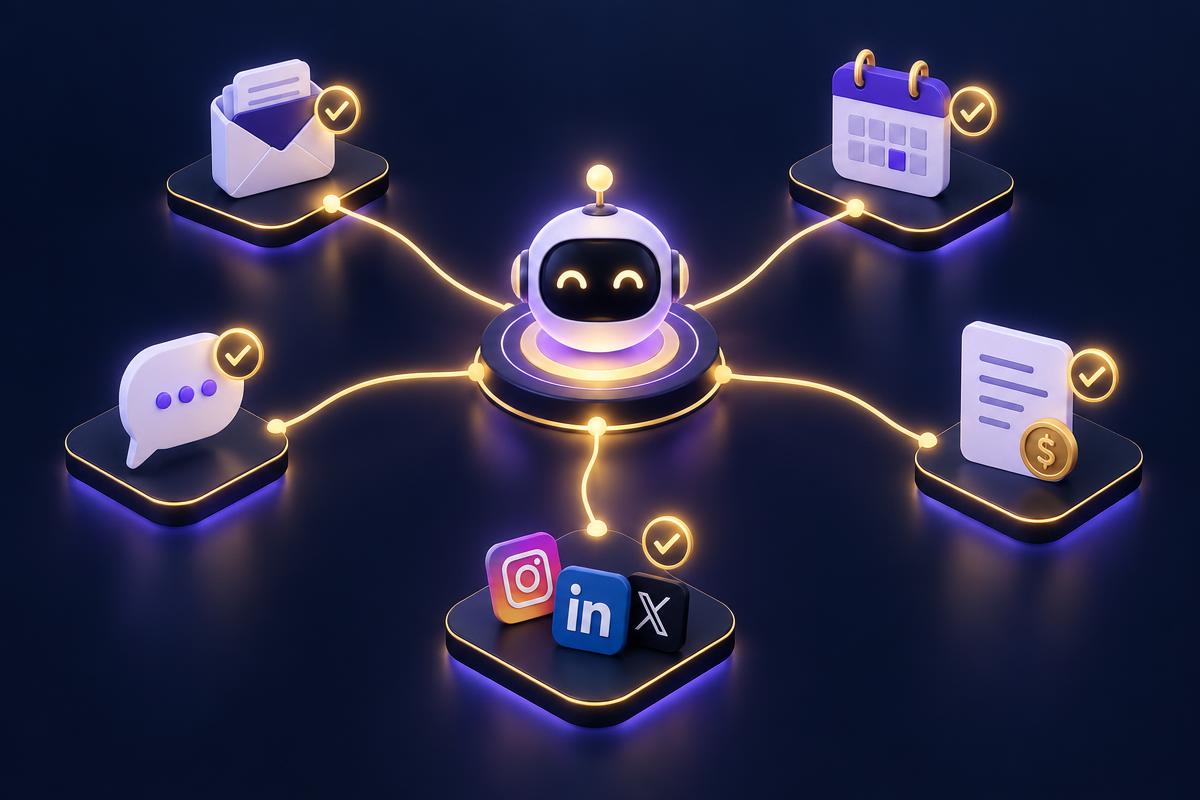
Five Tasks an Agent Can Take Off Your Plate
- Use 1
Enquiry and inbox triage
An agent reads incoming enquiries, drafts a reply in your tone, flags urgent messages and files the rest. You approve before anything sends, and stop losing leads on busy days.
- Use 2
Appointment follow-ups
After a booking, quote or consultation, an agent sends the reminder, the preparation note and the follow-up message on schedule. No-shows and cold leads shrink without you touching a calendar.
- Use 3
Review replies and requests
An agent drafts thoughtful replies to new reviews and sends review requests after completed jobs, so your public reputation keeps growing even when you are flat out.
- Use 4
Invoice and payment reminders
An agent watches for overdue invoices and sends polite, escalating reminders. Chasing payments is the task most owners hate most, which makes it a perfect first handover.
- Use 5
Content repurposing
Give an agent one piece of content, a post, a video or a newsletter, and it drafts versions for your other channels. You edit and approve; the blank-page work disappears.
Notice the pattern: every one of these tasks is repetitive, follows rules you could write down, and is annoying rather than difficult. That is exactly the profile of a good agent task. The work that requires taste, relationships or judgement stays with you.
What Can Agents Not Do Yet?
- Real judgement. An agent follows patterns. A furious customer, an unusual request or a sensitive situation still needs a human who understands context.
- Responsibility. If an agent sends the wrong message, the business wears it. That is why approval steps exist, and why "set and forget" is the one strategy to avoid.
- Zero-effort setup. Every good agent run starts with you writing down how the task is done. Skipping that step is how businesses automate their mistakes.
- Knowing your business. An agent does not know your best customers, your quiet season or your promises. You teach it, or it guesses.
How to Start with One Task, Safely
- Step 1
Pick one repetitive task
Choose something you do weekly that follows the same pattern every time, like enquiry replies or payment reminders. Repetition is what makes a task agent-friendly.
- Step 2
Write down your rules
Note exactly how you do the task today: what you check, what you say, what you never say. These notes become the agent's instructions.
- Step 3
Start in draft mode
Let the agent prepare work for your review instead of acting alone. Approve everything at first; automation comes after trust is earned.
- Step 4
Check every output early on
For the first weeks, read what the agent produces. Correct it, tighten the instructions, and watch accuracy climb.
- Step 5
Widen the scope slowly
Only when one task runs cleanly for weeks do you add a second. Businesses that automate five things at once usually automate chaos.
Most owners who follow this order report the same experience: the first two weeks feel like extra supervision, and by week four the task has quietly disappeared from their day. That is the honest promise of agents, hours back every week, not miracles.
Where Do You Learn the Skills Behind Agents?
Working well with agents is mostly clear instructions and good prompting, exactly the skills we teach at Market Me Global Academy. Chapter 1 builds your prompting foundations, Chapter 2 turns AI into a productive workflow, and Chapter 3 covers social content and AI video. See the full route on the AI marketing course page.
Want the applied version? The Small Business AI Action Kit turns these ideas into copy-and-use prompt workflows for everyday business tasks, at €19 during the launch offer. Or start with any of the digital downloads from €2.99.
Put AI to Work in Your Business
The Small Business AI Action Kit gives you practical prompt workflows for the tasks above, at a €19 launch price for the first 10 copies. Or begin with a focused PDF download from €2.99.
Honest teaching with no guaranteed time savings or income. Launch prices apply to the first 10 completed purchases of each download.
Frequently Asked Questions About AI Agents
What is an AI agent in simple terms?
An AI agent is software that can carry out a multi-step task on your behalf, not just answer a single question. You give it a goal and rules, and it reads, drafts, checks and acts within the limits you set, usually with your approval before anything important goes out.
How is an AI agent different from a chatbot?
A chatbot answers one message at a time and stops. An agent pursues a goal across several steps: reading an enquiry, checking your calendar, drafting a reply and scheduling a follow-up. Chatbots talk; agents get work done.
What can AI agents realistically do for a small business today?
The reliable wins are repetitive, pattern-based tasks: triaging enquiries, drafting replies, sending appointment and payment follow-ups, requesting and answering reviews, and repurposing content across channels. All of these work best with human approval built in.
What can AI agents not do yet?
Agents cannot exercise real judgement, take responsibility, handle genuinely unusual situations well, or know your business the way you do. They also need setup and supervision. Treat them as fast, tireless assistants, never as staff you can leave unsupervised.
Do I need technical skills to use an AI agent?
No. Most modern tools let you describe the task in plain language and connect your email, calendar or social accounts with a few clicks. The skill that matters is explaining your process clearly, which is a prompting skill, not a coding skill.
Are AI agents expensive for a small business?
Costs range from free tiers to monthly subscriptions roughly comparable to a streaming service or two. The real investment is the hour or two of setup and the early supervision while the agent learns your rules.
Is it safe to let an AI agent talk to my customers?
It is safe when you keep a human approval step for anything customer-facing, especially at the start. Most problems come from businesses switching on full automation before the agent's instructions are properly tested.
Which task should I automate first?
Pick the task that is most repetitive and least sensitive: usually enquiry triage, review replies or payment reminders. Avoid automating complaints, refunds or anything involving money movement until you have months of trust built up.
Will an AI agent replace my staff?
For most small businesses, agents remove the admin that buries existing people rather than replacing them. The realistic outcome is the same team with hours back each week for the work that actually needs a human.
Where can I learn to set up and instruct AI agents?
Agent work is mostly clear instructions and good prompting. Market Me Global Academy teaches those foundations across its three chapters, the Small Business AI Action Kit applies them to everyday business tasks, and the digital downloads from €2.99 offer a self-paced start.
This week's action
Write down the one task you repeat most each week, step by step, exactly as you do it. That page of notes is 90% of what an agent needs. You are closer than you think.
About the author
Emmanuel Abou Chabke is the founder of Market Me Global and the instructor behind Market Me Global Academy. He teaches practical AI workflows for marketers, creators and small businesses.